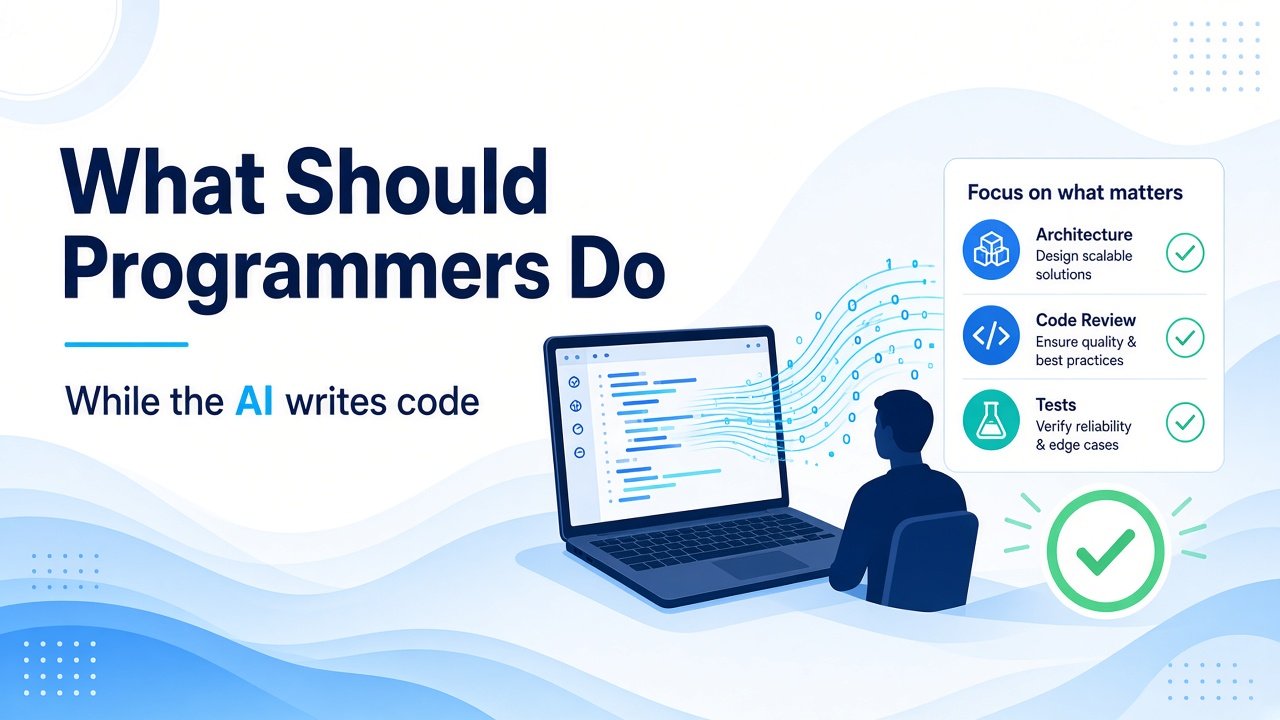
What Should Programmers Do While the AI Writes Code?
- DataSync
- 16 Sep, 2026
- 02 Mins read
- Engineering
When AI can draft functions, tests, and refactors quickly, the programmer’s job does not disappear. It shifts. The highest-value work moves upstream and downstream of generation: clarifying intent, shaping the design, and verifying that the result is safe to ship.
The teams getting leverage from AI treat it as a fast junior collaborator, not as the owner of the system.
Clarify the Problem Before Generation Starts
AI writes better code when the problem is sharp.
Before prompting, define the user outcome, constraints, edge cases, and non-goals. Ambiguous requests produce plausible code that solves the wrong problem. A few minutes of framing usually saves hours of cleanup.
Good inputs include:
- Expected behavior
- Data contracts and APIs
- Performance or security constraints
- What must not change
Own the Architecture Decisions
AI can suggest patterns. Programmers should still decide structure.
Choose where logic lives, how modules communicate, what abstractions are worth keeping, and which shortcuts create future debt. If every generated snippet invents its own style, the codebase becomes harder to maintain than before AI existed.
Architecture remains a human responsibility because it compounds over time.
Review Diffs Like Production Changes
Speed without review creates silent regressions.
Read the generated code for correctness, naming, error handling, security assumptions, and fit with existing patterns. Ask whether you would approve the same pull request from a teammate. If not, revise it before it lands.
Treat AI output as a draft, never as an automatic merge.
Strengthen Tests and Edge Cases
AI often optimizes for the happy path.
Programmers should push on failure modes: invalid input, timeouts, auth gaps, empty states, concurrency, and migration risk. Write or demand tests that prove behavior under pressure. This is one of the highest-ROI activities while generation is happening.
Keep Context Fresh
Models do not automatically know your latest domain rules, incidents, or partner constraints.
Feed them current interfaces, examples, and acceptance criteria. Correct wrong assumptions early. The quality of generated code tracks the quality of the context you provide.
Stay Accountable for Production
When something breaks at 2 a.m., ownership still sits with the team.
That means understanding the code well enough to debug it, document decisions, and improve the system after release. Using AI does not transfer accountability. It increases the need for engineers who can explain and defend what shipped.
Final Takeaway
While AI writes code, programmers should define the problem, decide the architecture, review ruthlessly, harden tests, and own production outcomes.
The advantage is not typing less. It is spending more time on judgment, clarity, and quality where those matter most.
Our Team Members