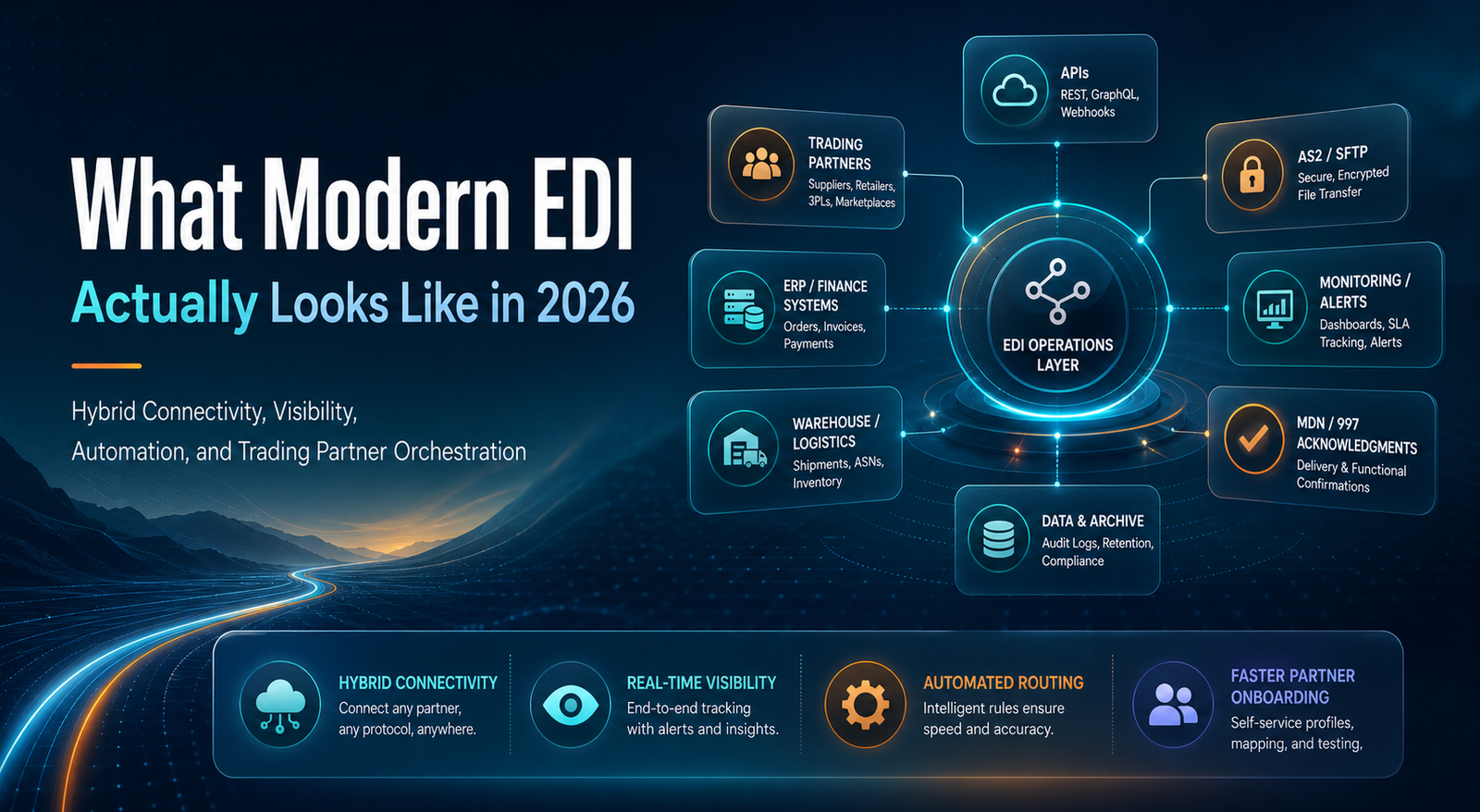
What Modern EDI Actually Looks Like in 2026
- DataSync
- 17 Aug, 2026
- 02 Mins read
- Edi
Modern EDI in 2026 does not look like a standalone file transfer tool sitting at the edge of the business. It looks more like an integration layer that connects trading partners, internal systems, APIs, monitoring, and workflow automation in one place.
Modern EDI Is More Than Document Translation
Traditional EDI was often viewed as a narrow function: convert a file, send it, wait for an acknowledgment, and move on.
In 2026, modern EDI platforms still handle ANSI X12, AS2, and SFTP, but they also support broader orchestration across ERP systems, warehouse platforms, finance systems, customer portals, and API-based services.
That means EDI is no longer only about translating documents. It is about managing how business data moves across the full B2B workflow.
What a Modern EDI Stack Usually Includes
A modern EDI environment typically includes:
- Trading partner onboarding and configuration
- Document validation and mapping
- AS2, SFTP, API, or hybrid connectivity
- Real-time monitoring and alerting
- Retry handling and controlled reprocessing
- Audit trails and acknowledgment tracking
Instead of isolated message exchange, teams expect one operating layer where partner activity, document status, and failures are visible in real time.
APIs and EDI Work Together
In 2026, many businesses are not replacing EDI with APIs. They are combining both.
EDI still handles formal B2B documents such as purchase orders, invoices, and shipment notices. APIs are often used for faster actions such as status lookups, platform events, inventory checks, and customer-facing experiences.
The result is a more flexible architecture: EDI for structured partner documents, APIs for real-time application workflows.
Visibility Matters as Much as Connectivity
One of the biggest changes in modern EDI is the expectation of visibility.
Teams want to know:
- Which partner sent the transaction
- Whether it passed validation
- Whether an MDN or 997 was received
- Whether the message was retried
- Where the workflow failed, if it failed at all
Modern EDI platforms are expected to provide dashboards, alerts, logs, and searchable history instead of leaving teams to investigate issues manually.
Automation Is a Core Requirement
Modern EDI also means less manual intervention.
In practice, that includes automatic routing, duplicate detection, exception handling, acknowledgment tracking, and faster partner onboarding. The goal is not just to exchange files, but to reduce operational effort as transaction volume grows.
Final Takeaway
What modern EDI looks like in 2026 is simple: connected systems, better visibility, hybrid API plus EDI workflows, and more automation around every transaction.
The companies getting the most value from EDI are usually the ones treating it as a modern B2B operations layer, not just a transport channel.
Our Team Members