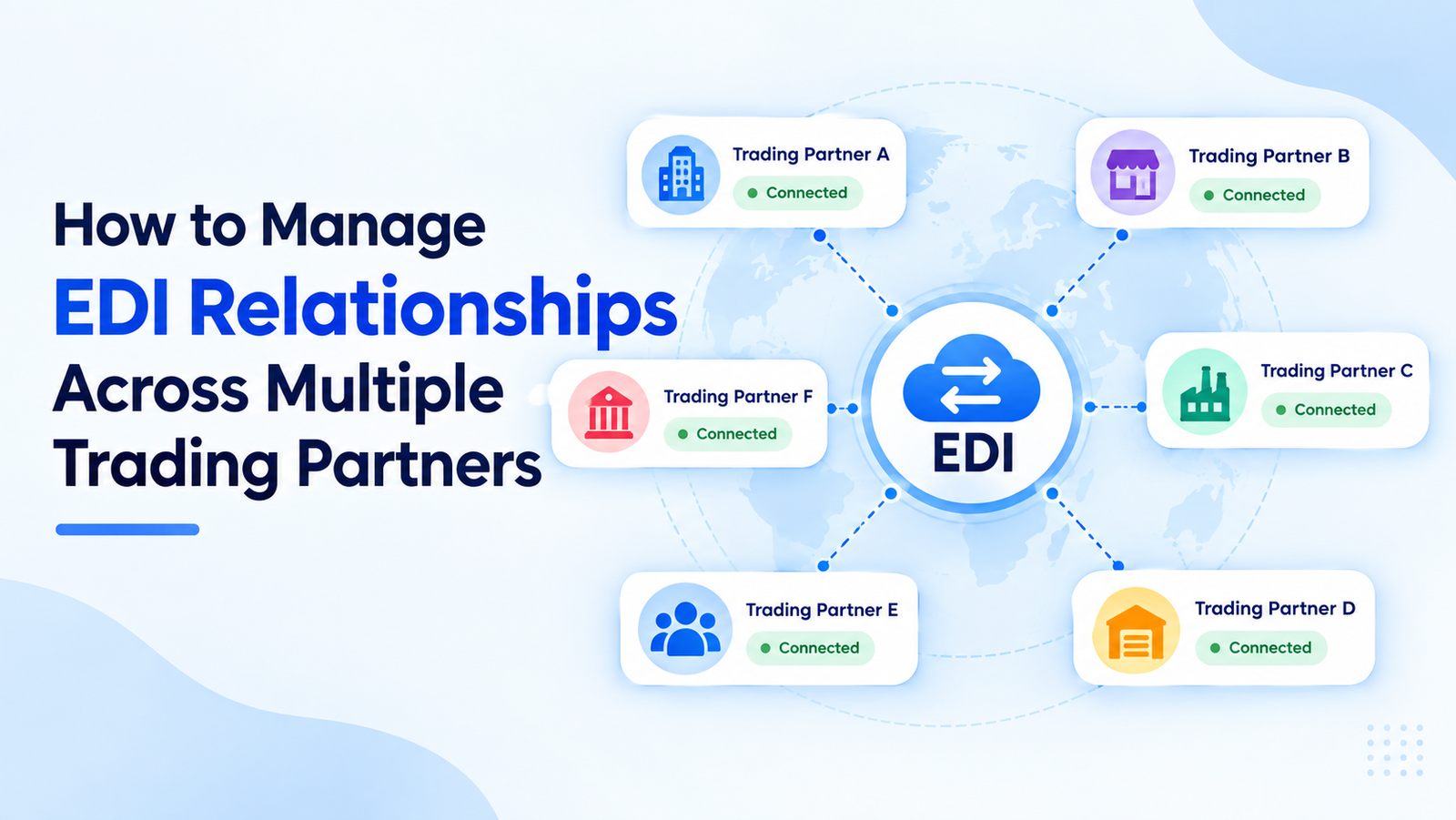
How to Manage EDI Relationships Across Multiple Trading Partners
- DataSync
- 12 Sep, 2026
- 03 Mins read
- Edi
Managing EDI with one trading partner is usually straightforward. Managing it across many partners is where complexity shows up: different IDs, maps, transport methods, acknowledgment rules, testing paths, and support contacts.
The teams that stay in control treat EDI relationships as an operating system, not a collection of one-off setups.
Start With a Standard Partner Profile
Every trading partner should have the same core profile structure, even if the values differ.
A useful partner profile typically includes:
- Partner identity and legal name
- Sender and receiver IDs
- Supported transaction sets
- Transport method such as AS2, SFTP, or API
- Map and validation rules
- Acknowledgment expectations
- Business and technical contacts
When profiles are inconsistent, onboarding slows down and production issues take longer to diagnose.
Standardize Onboarding, Customize Only Where Needed
Multi-partner EDI works best when the onboarding process is repeatable.
Keep a shared checklist for discovery, setup, testing, certification, and go-live. Then customize only the partner-specific pieces: document versions, retailer rules, certificate details, or timing requirements.
This balance matters. Full customization for every partner creates chaos. Zero customization creates failed exchanges.
Track Document Differences Explicitly
Not every partner uses the same documents the same way.
One partner may require 850, 855, 856, and 810. Another may only need purchase orders and invoices. A third may have stricter ASN packing rules or different acknowledgment expectations.
Document those differences clearly so operations teams do not rely on tribal knowledge when something fails in production.
Separate Connectivity From Business Logic
Across multiple partners, connectivity and mapping should not be mixed into one opaque process.
Treat transport settings, certificates, endpoints, and retry behavior as one layer. Treat maps, validations, and routing as another.
That separation makes it easier to onboard a new partner on an existing protocol, or update a map without touching the connection.
Centralize Monitoring Across Partners
Once you have more than a few partners, visibility becomes the control point.
Teams should be able to see:
- Which partner sent or received a document
- Whether validation passed
- Whether an MDN or 997 came back
- Which partners are generating the most exceptions
- Where retries or reprocessing are happening
Without shared monitoring, each partner relationship becomes a separate firefight.
Assign Clear Ownership for Exceptions
Technical setup is not enough. Every EDI relationship needs clear support ownership.
Define who handles transport failures, who reviews mapping rejects, who contacts the partner, and who approves production changes. When ownership is unclear, issues bounce between EDI, IT, operations, and the trading partner with no resolution path.
Keep Test and Production Profiles Separate
One common multi-partner mistake is letting test settings bleed into production.
Maintain separate identifiers, certificates, endpoints, and environment notes for each partner. That reduces accidental production traffic during testing and makes cutover cleaner when a partner goes live.
Final Takeaway
Managing EDI relationships across multiple trading partners is less about adding more maps and more about building consistent operating practices.
Standard partner profiles, repeatable onboarding, clear document differences, centralized monitoring, and defined ownership are what keep multi-partner EDI scalable as volume grows.
Our Team Members