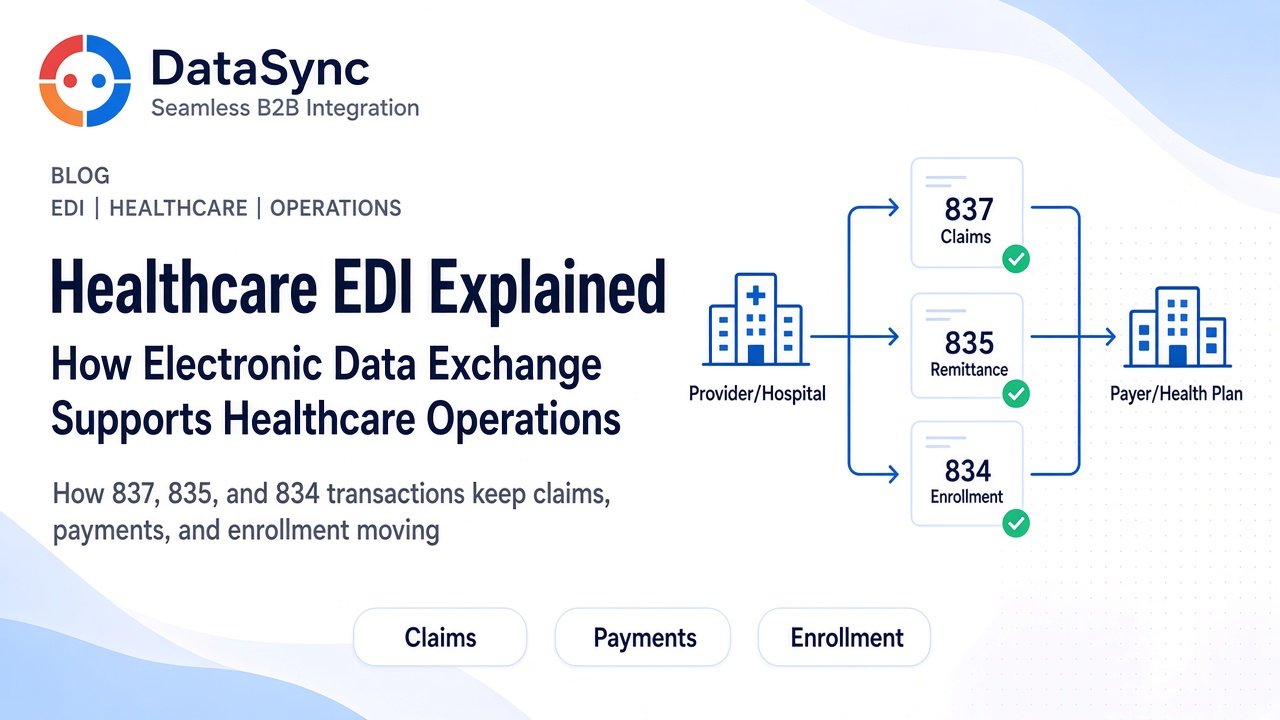
Healthcare EDI Explained: How Electronic Data Exchange Supports Healthcare Operations
- DataSync
- 10 Oct, 2026
- 04 Mins read
- Edi
Healthcare EDI is the electronic exchange of standardized business documents between providers, payers, clearinghouses, and other healthcare organizations. Instead of relying on paper forms, portals, or one-off file formats, healthcare EDI uses structured transactions to move claims, payments, enrollment updates, and related data through operational workflows.
For healthcare operations teams, EDI is not just an integration topic. It is one of the core systems that determines how quickly claims are submitted, how remittance is reconciled, and how enrollment changes reach the right systems.
Why Healthcare Operations Depend on EDI
Healthcare organizations exchange large volumes of recurring transactions every day. Manual processing cannot keep up with that volume without delays, errors, and higher administrative cost.
EDI supports healthcare operations by:
- Standardizing how partners exchange data
- Reducing manual rekeying and document handling
- Speeding up claims and payment cycles
- Improving consistency across payers and providers
- Creating a clearer audit trail for operational and compliance reviews
When EDI works well, operations teams spend less time chasing missing information and more time resolving true exceptions.
The Core Healthcare EDI Transactions
Most healthcare EDI programs center on a small set of high-impact transaction types.
EDI 837: Health Care Claim
The 837 is used to submit claims or encounter information from a provider to a payer or clearinghouse. Teams commonly work with:
- 837P for professional claims
- 837I for institutional claims
- 837D for dental claims
This is the transaction that starts the electronic claims lifecycle.
EDI 835: Health Care Payment and Remittance Advice
The 835 communicates payment and remittance details from a payer back to a provider. It helps finance and revenue cycle teams understand what was paid, adjusted, denied, or left pending.
Without reliable 835 processing, payment posting and reconciliation become slow and error-prone.
EDI 834: Benefit Enrollment and Maintenance
The 834 supports enrollment and member maintenance workflows. It is used when members are added, updated, or removed from a health plan.
Enrollment accuracy matters because downstream claims and eligibility processes depend on correct member data.
How Electronic Data Exchange Supports Daily Operations
Healthcare EDI connects several operational functions into one continuous flow.
A typical claims and payment cycle looks like this:
- A provider submits an 837 claim.
- The payer or clearinghouse validates and processes the claim.
- Acknowledgments confirm receipt and structural acceptance.
- An 835 returns remittance and payment details.
- The provider posts payment and investigates any denials or adjustments.
In parallel, 834 enrollment updates keep membership data current so claims and eligibility checks stay aligned with the right plan and member records.
This is how electronic data exchange supports healthcare operations in practice: it links clinical-adjacent administrative processes into a repeatable, trackable workflow.
What Makes Healthcare EDI Different From Other EDI
Healthcare EDI shares the same foundation as other B2B EDI programs, but it has unique requirements.
- Transactions often follow HIPAA-adopted standards
- Payer companion guides add partner-specific rules
- Data sensitivity and privacy requirements are higher
- Acknowledgments and rejection handling are mission-critical
- Enrollment, claims, and remittance must stay synchronized
That means healthcare EDI success depends on more than file delivery. It depends on standards compliance, partner-specific validation, secure exchange, and strong operational monitoring.
Where Healthcare EDI Programs Usually Break Down
Even mature healthcare organizations struggle when EDI visibility is weak.
Common operational pain points include:
- Claims rejected after submission because of mapping or companion guide issues
- Remittance files that arrive but cannot be posted cleanly
- Enrollment updates that fail silently and create eligibility mismatches
- Unclear ownership when a transaction is stuck between provider, clearinghouse, and payer
- Limited monitoring across acknowledgments, application advice, and business exceptions
These issues create delayed payments, rework, and higher administrative burden.
What Strong Healthcare EDI Operations Look Like
High-performing healthcare EDI programs treat electronic exchange as an operations capability, not only a technical connection.
They typically focus on:
- Reliable support for 837, 835, and 834 workflows
- Clear exception handling when transactions fail
- End-to-end tracking from submission to remittance
- Partner-specific validation before production issues appear
- Secure transport and audit-ready transaction history
When those pieces are in place, electronic data exchange becomes a stable foundation for revenue cycle and membership operations.
Final Takeaway
Healthcare EDI is how electronic data exchange supports healthcare operations at scale. Through transactions like the 837, 835, and 834, providers and payers can move claims, payments, and enrollment data with far more speed and consistency than manual processes allow.
Teams that understand healthcare EDI as an operational system, not just a file format, are better positioned to reduce administrative friction, improve payment cycles, and keep critical healthcare workflows moving.
Our Team Members