Healthcare EDI Compliance Basics for 834, 835, and 837 Programs
- DataSync
- 23 Aug, 2026
- 03 Mins read
- Edi
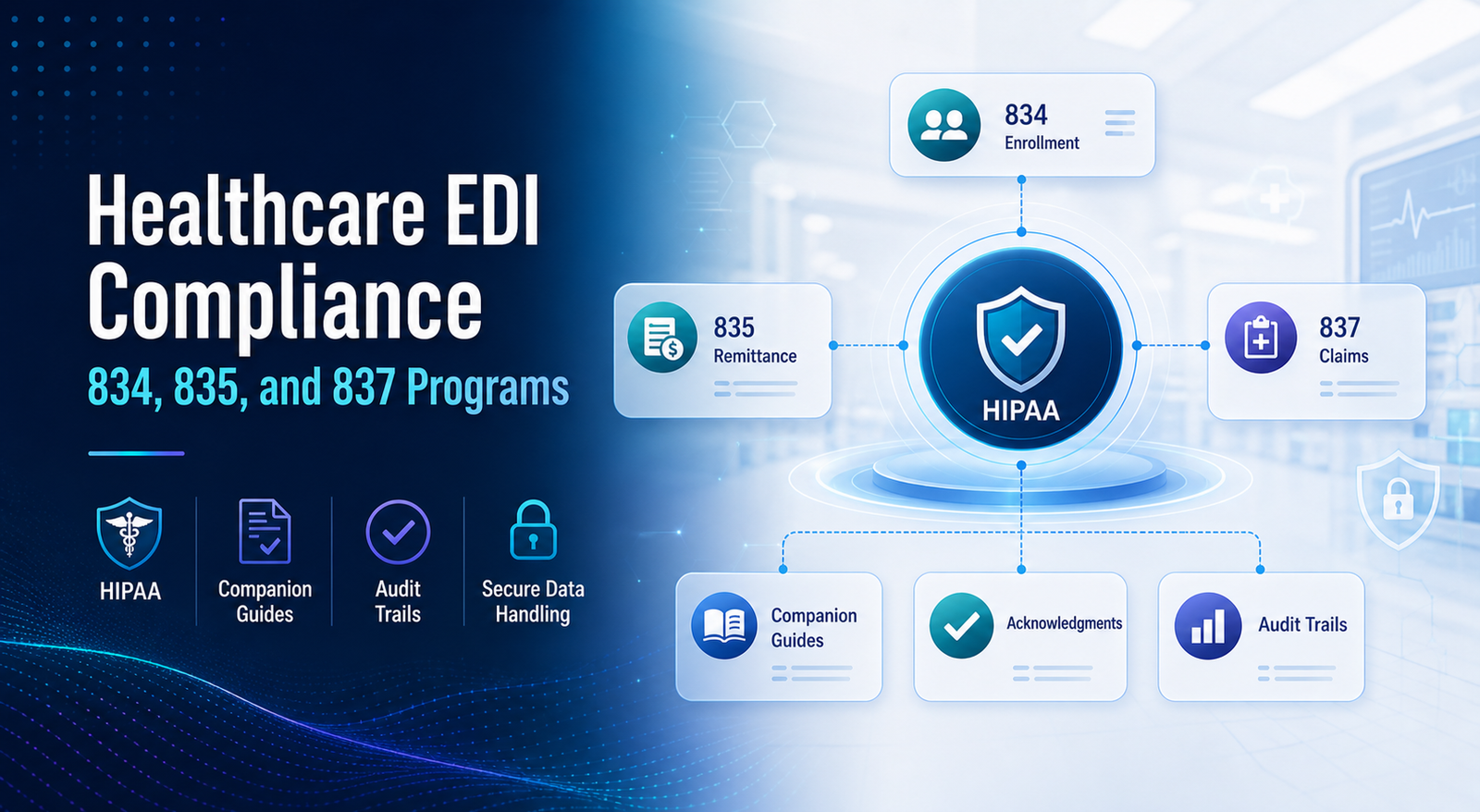
Healthcare EDI compliance is not only about sending files successfully. For 834, 835, and 837 programs, compliance depends on using the correct HIPAA-adopted transaction standards, following payer or partner companion guides, protecting sensitive data, and maintaining enough visibility to prove what happened in the workflow.
For operations and integration teams, these are the basics that matter most.
What 834, 835, and 837 Mean
The 834 Benefit Enrollment and Maintenance transaction is used to enroll or disenroll members in a health plan.
The 835 Health Care Payment and Remittance Advice transaction is used to communicate payment details and remittance information from a health plan to a provider.
The 837 Health Care Claim transaction is used to submit claims or encounter information. In practice, teams may work with 837P for professional claims, 837I for institutional claims, and sometimes 837D for dental claims.
Together, these transaction sets support enrollment, claims, and payment workflows across many healthcare EDI programs.
Start with HIPAA Transaction Standards
At the most basic level, healthcare EDI compliance means using the adopted HIPAA transaction standards for the transaction you are sending.
For teams working electronically with covered entities, that means the transaction must match the required standard format rather than a custom proprietary layout. This is one of the biggest differences between healthcare EDI and many general B2B EDI programs.
If the format is wrong, even a valid business event can still fail compliance or payer acceptance.
Companion Guides Matter
Many teams assume HIPAA compliance alone is enough. In real healthcare EDI operations, it is not.
Health plans, clearinghouses, and government programs often publish companion guides that explain how they expect the standard transaction to be implemented in their environment.
For example, a partner may define:
- Required loops or segments
- Code usage expectations
- Payer-specific identifiers
- Testing requirements
- Response and acknowledgment handling
A transaction can be HIPAA-standard and still fail if it does not align with the trading partner’s companion guide.
Acknowledgments and Error Handling Are Part of Compliance
Compliance is also operational.
Teams should track whether transactions were accepted, rejected, or left unresolved. For healthcare EDI, that usually means monitoring acknowledgments, validation responses, and rejection handling carefully.
Without structured error handling, organizations may miss enrollment failures, claim rejections, or payment-posting issues even though files were technically transmitted.
A strong program should track:
- Submission status
- Acknowledgment status
- Rejection reasons
- Retry and correction activity
- Final resolution of the transaction
Protect PHI and Control Access
Healthcare EDI programs often process protected health information (PHI), so compliance also depends on access control, encryption, secure transmission, and auditability.
That includes securing channels such as SFTP or AS2, limiting who can view sensitive files, and keeping transaction histories available for review.
Operations teams do not need to become privacy attorneys, but they do need workflows that reduce exposure and support accountability.
Build for Audit Readiness
One of the easiest ways to strengthen healthcare EDI compliance is to make the program easier to explain.
Teams should be able to show:
- Which file was sent or received
- Which payer or partner was involved
- What standard transaction was used
- Whether the transaction passed validation
- What happened after a rejection or exception
That level of visibility supports both day-to-day operations and audit readiness.
Final Takeaway
Healthcare EDI compliance basics for 834, 835, and 837 programs come down to five things: use the correct HIPAA transaction standard, follow companion guides, monitor acknowledgments and rejections, protect PHI, and maintain clear audit trails.
When those basics are in place, healthcare EDI programs become more reliable, more defensible, and much easier to operate at scale.
Our Team Members