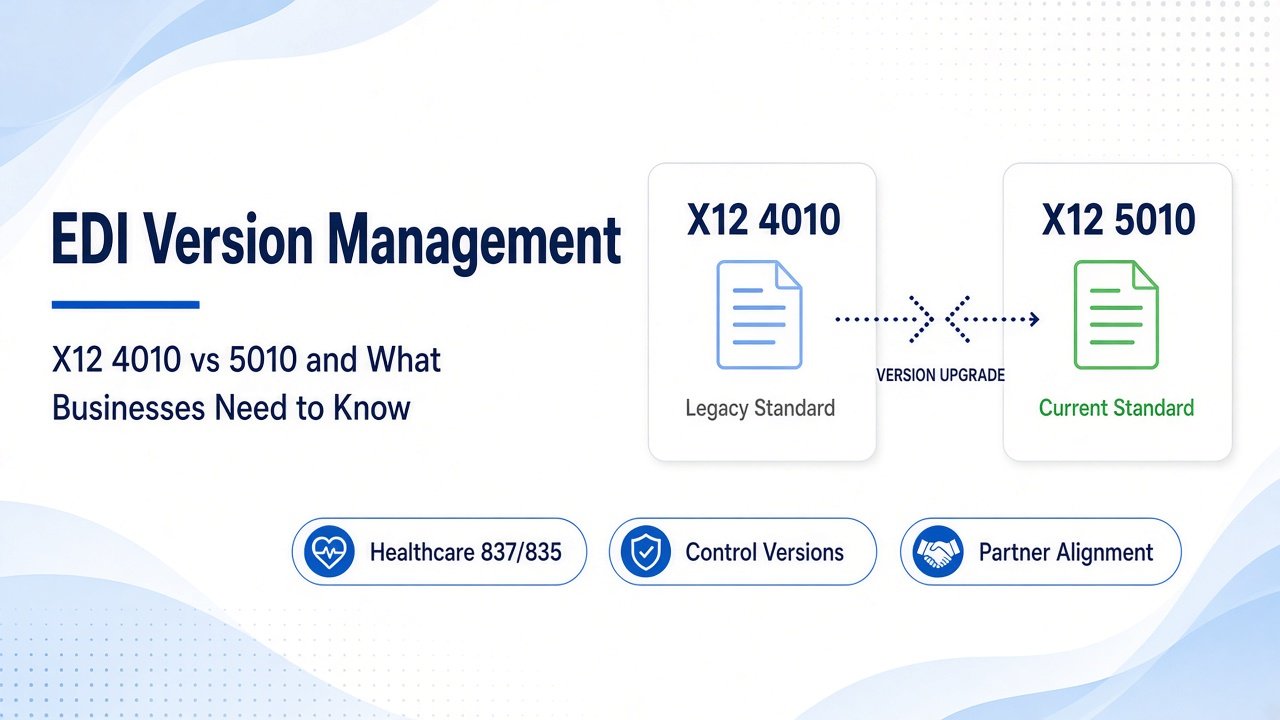
EDI Version Management: X12 4010 vs 5010 and What Businesses Need to Know
- DataSync
- 23 Sep, 2026
- 03 Mins read
- Edi
X12 is not one format. It is a family of versions. 4010 and 5010 are the two most businesses still have to manage—sometimes in the same partner book at the same time.
Version management is how teams keep maps, validations, and acknowledgments aligned so a partner on 4010 and a partner on 5010 do not collide in production.
Why Version Still Matters
The transaction set number is not enough. An 837 in 4010 is not the same document as an 837 in 5010. Segment usage, qualifiers, situational rules, and loop structures change.
If your platform treats “837” as one map, version mismatches show up as rejects, silent data loss, or acknowledgments that do not match what the partner expected.
What 4010 and 5010 Actually Are
4010 is the older X12 release still common in retail, manufacturing, and some logistics flows. Many 850, 810, and 856 relationships still run on it because partners never had a mandate to move.
5010 is the later release required for HIPAA-covered healthcare transactions in the United States—claims (837), remittance (835), eligibility (270/271), and related sets. It tightened structure, expanded code usage, and reduced the ambiguity that 4010 allowed.
The same company can be 5010 on the healthcare side and 4010 with a retailer. That split is normal. Treating one version as the company standard is what breaks exchanges.
The Differences That Affect Operations
Ops teams do not need every TR3 page. They need the differences that change setup and support:
- GS version / release identifiers must match the partner’s expected release
- 5010 is stricter about situational segments and required data
- Code lists and qualifier values are not interchangeable across versions
- Acknowledgments and implementation guides are version-specific
- A “small” map reuse from 4010 to 5010 often drops or misplaces fields
Most failed upgrades are not transport problems. They are version-wrong maps wearing the right transaction number.
Healthcare Made 5010 Non-Optional
For covered healthcare transactions, 5010 is the compliance baseline, not a preference.
Payers, clearinghouses, and providers expect 5010 structure, control values, and content rules. Sending 4010-shaped claims into a 5010 relationship creates rejects that look like data quality issues when the real issue is the wrong release.
If healthcare is in the mix, version is a compliance control—not just an EDI setting.
Version Must Live on the Partner Profile
Do not store version as a global platform default.
Each trading partner relationship should record:
- X12 release (4010, 5010, or another agreed version)
- Transaction sets covered by that version
- Implementation guide or companion-guide reference
- Map and validation profile tied to that release
- Test and production cutover notes
When version sits on the partner profile, routing and mapping can choose the right path automatically. When it lives in someone’s head, every new partner becomes a guess.
Upgrade Without Breaking the Other Partners
Moving one partner from 4010 to 5010 should not rewrite every other map.
A safe version change:
- Keeps the existing 4010 relationship intact until certification is done
- Builds or clones a 5010 map instead of overwriting the old one
- Tests with partner-provided samples, not only internal files
- Confirms acknowledgments and downstream ERP fields still land
- Cuts over with a dated go-live and a rollback path
Version upgrades fail when teams edit the live 4010 map “in place” and discover another partner was still using it.
Final Takeaway
X12 4010 and 5010 are different contracts, even when the transaction number looks the same.
Businesses stay safe by treating version as partner-specific configuration, mapping each release separately, and upgrading with a parallel path—not a global switch.
Our Team Members