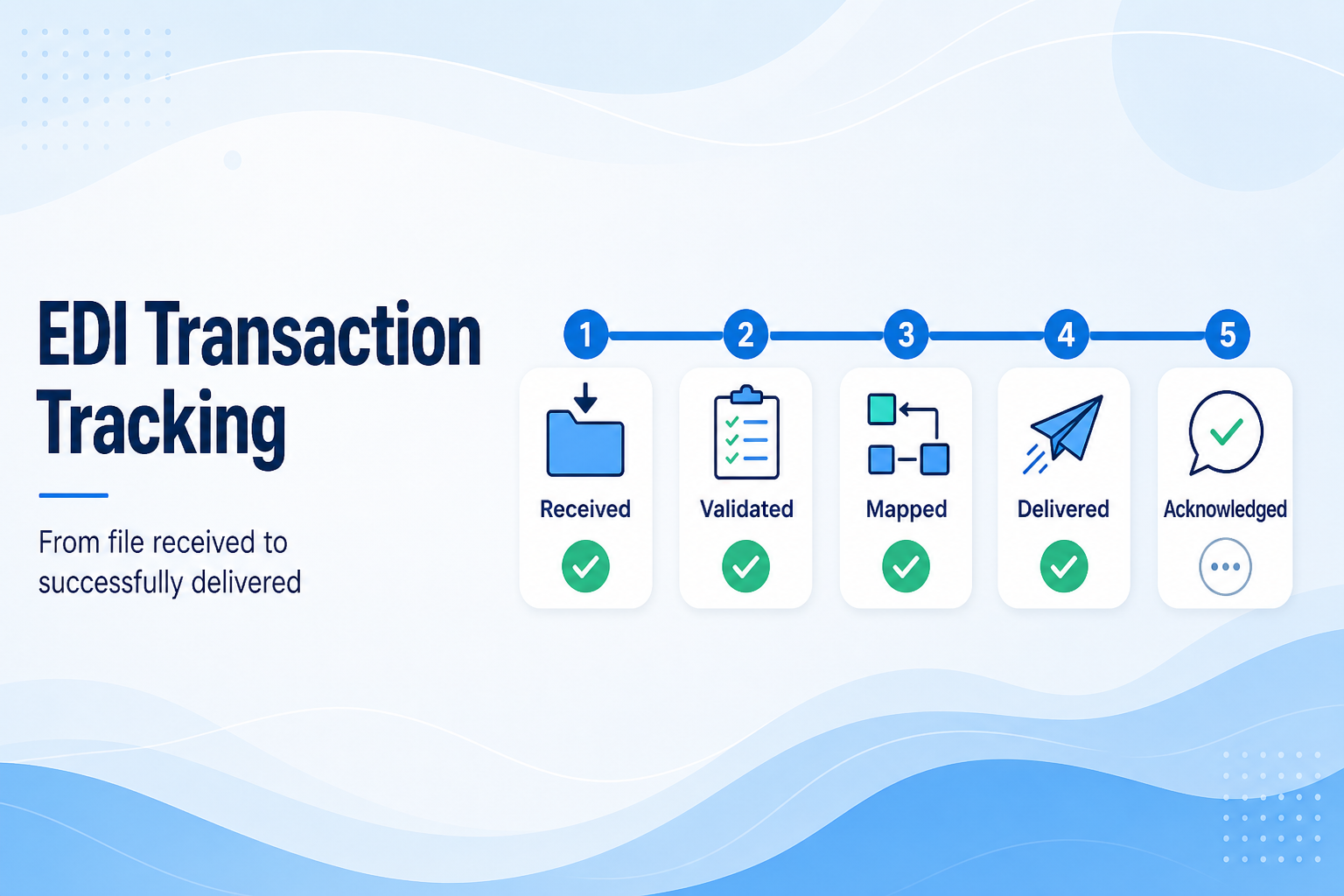
EDI Transaction Tracking: From File Received to Successfully Delivered
- DataSync
- 18 Sep, 2026
- 02 Mins read
- Edi
EDI transaction tracking answers one operational question: did this document make it from receipt to successful delivery? Without clear status at each step, teams chase missing purchase orders, late ASNs, and invoice disputes with incomplete evidence.
Strong tracking turns EDI from a black box into a visible workflow.
Start With File Received
Tracking begins the moment a file lands.
That means recording who sent it, when it arrived, which transport was used (AS2, SFTP, or API), and whether transport confirmation such as an MDN came back. If receipt is not logged, everything downstream becomes harder to prove.
Validate Before You Process
A received file is not yet a successful transaction.
Validation checks structure, required segments, partner rules, and duplicates. Tracking should show whether validation passed, failed, or needs review—and preserve the original payload for reprocessing when something is wrong.
Map and Route to the Right Destination
After validation, the document is transformed and routed.
Tracking at this stage should identify which partner profile applied, which map ran, which transaction set was detected (850, 856, 810, and others), and which system or mailbox is the next destination. When routing is opaque, delivery failures look like random outages.
Confirm Delivery, Not Just Send
Sending a file is not the same as delivering it.
Outbound tracking should capture send attempts, retries, endpoint responses, and final delivery status. For AS2, that often includes MDN success. For SFTP or API flows, it may include transfer confirmation or application receipt.
Close the Loop With Acknowledgments
Many programs are not complete until a 997, 999, or application advice returns.
Tracking acknowledgments ties the business outcome to the technical exchange: accepted, partially accepted, or rejected. Without that link, teams may assume success while the partner never processed the document.
Make Exceptions Actionable
The value of tracking shows up when something fails.
Operators need to see where the break happened—receipt, validation, mapping, transport, or acknowledgment—and who owns the next step. Clear timelines, searchable IDs, and reprocess options reduce mean time to recovery.
Final Takeaway
EDI transaction tracking follows the full path from file received to successfully delivered: receipt, validation, transformation, delivery, and acknowledgment.
When each stage is visible, EDI operations scale with confidence instead of relying on inbox archaeology and partner guesswork.
Our Team Members