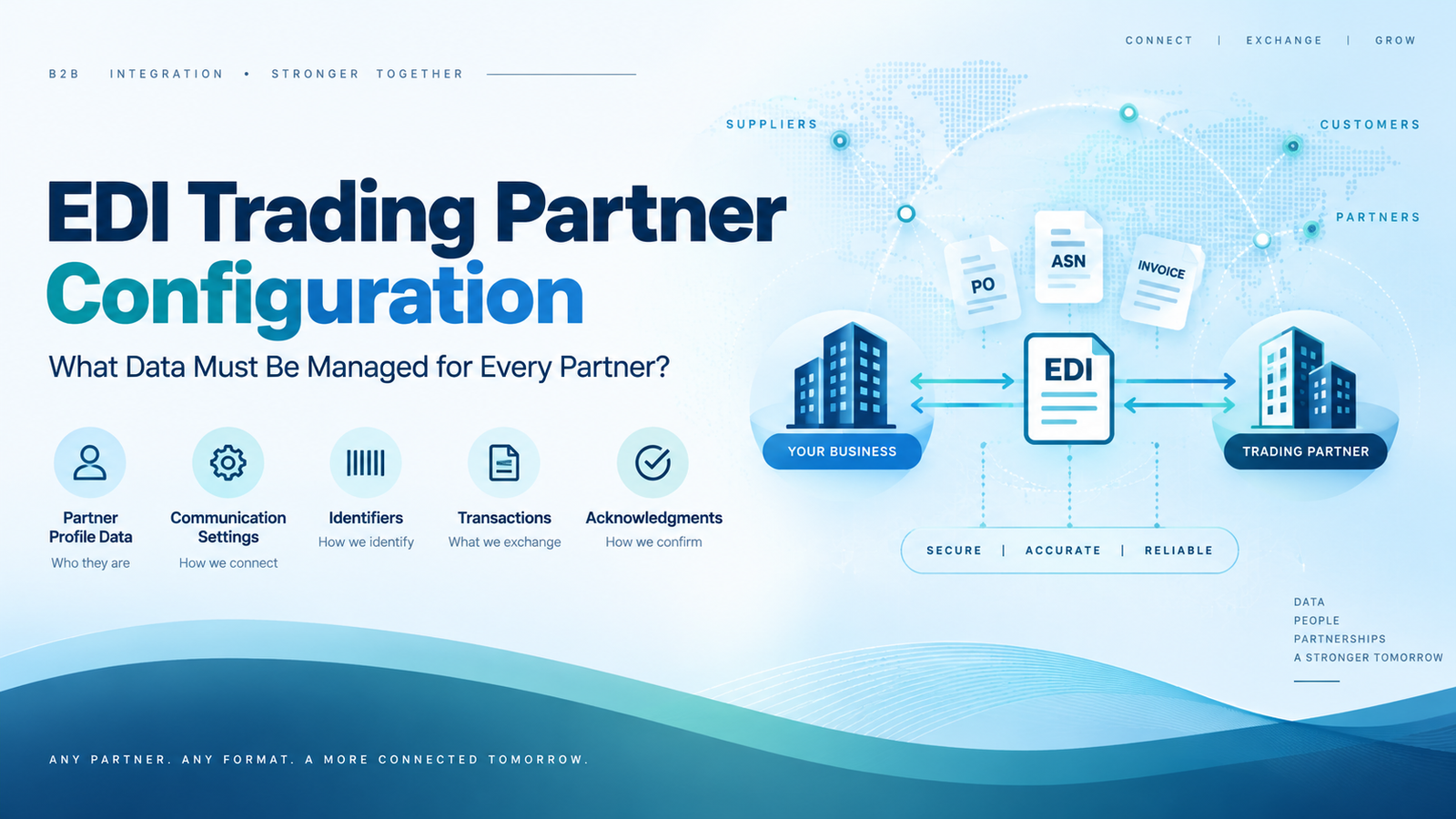
EDI Trading Partner Configuration: What Data Should You Manage for Every Partner?
- DataSync
- 11 Sep, 2026
- 04 Mins read
- Edi
Every EDI trading partner needs more than a connection and a map. Each partner also needs a clear configuration profile that tells your EDI platform how to identify messages, exchange files, validate data, route documents, send acknowledgments, and support issues after go-live.
When this data is incomplete or outdated, teams run into preventable problems: rejected documents, missing acknowledgments, failed AS2 transfers, wrong routing, expired certificates, and slow troubleshooting.
What Is EDI Trading Partner Configuration?
EDI trading partner configuration is the set of technical, business, and operational details used to manage document exchange with a specific partner.
It usually answers questions such as:
- Who is this partner?
- Which documents do they send and receive?
- How should files be transported?
- Which IDs, certificates, maps, and validation rules apply?
- Who owns issues when transactions fail?
A good partner profile becomes the single source of truth for implementation, support, compliance, and day-to-day operations.
1. Partner Identity Data
Start with the information your EDI platform uses to recognize the partner.
This often includes:
- Legal company name
- Partner display name
- Internal partner code
- Sender and receiver IDs
- ISA and GS identifiers
- Qualifiers
- DUNS, GLN, vendor, customer, or location IDs
- Separate test and production identifiers
These values matter because the EDI system uses them to match inbound and outbound files to the correct partner profile.
2. Supported Transaction Sets
Each partner should have a clear list of supported EDI documents.
Common examples include:
- EDI 850 for purchase orders
- EDI 855 for purchase order acknowledgments
- EDI 856 for advance ship notices
- EDI 810 for invoices
- EDI 846 for inventory updates
- EDI 940 and EDI 945 for warehouse fulfillment
- EDI 997, 999, or 824 for acknowledgments and application advice
Document scope should be explicit. If teams assume a partner supports a transaction set before confirming it, onboarding and production support can get messy quickly.
3. Transport Settings
Trading partner configuration should define how files move between systems.
For AS2, teams should manage:
- AS2 URL
- AS2 sender and receiver IDs
- Signing and encryption requirements
- MDN settings
- Compression rules
- Retry and timeout behavior
For SFTP, teams should manage:
- Hostname and port
- Username or SSH key details
- Inbound and outbound folder paths
- File naming rules
- Polling schedule
- Archive and error folders
Transport details should be separated by environment so test traffic does not accidentally reach production.
4. Certificates and Security Rules
Certificate data should be treated as operationally important, not just a setup detail.
Track:
- Encryption certificate
- Signing certificate
- Certificate owner
- Expiration date
- Rotation date
- Partner confirmation status
- TLS or encryption expectations
- Backup or rollback plan
Expired or mismatched certificates are one of the most avoidable causes of AS2 downtime.
5. Mapping and Transformation Rules
Every partner may have slightly different document expectations, even when the transaction set is the same.
Partner configuration should point to the correct:
- Inbound maps
- Outbound maps
- ERP, WMS, TMS, or API format
- Field-level transformations
- Code translations
- Default values
- Routing logic
This is especially important when multiple partners use the same document type but different implementation guides.
6. Validation and Business Rules
Syntax validation is only the first layer. Many failures happen because the data is technically valid but does not meet partner business rules.
Useful validation data includes:
- Required segments and elements
- Accepted code values
- Unit of measure rules
- Item or SKU requirements
- Ship-from and ship-to location rules
- Date and timing requirements
- Quantity tolerance rules
- Duplicate detection logic
Strong validation catches issues before they become chargebacks, rejected invoices, delayed shipments, or manual support work.
7. Acknowledgment Requirements
Each partner profile should define which acknowledgments are expected and how quickly they should arrive.
Track requirements for:
- AS2 MDNs
- EDI 997 Functional Acknowledgments
- EDI 999 Implementation Acknowledgments
- EDI 824 Application Advice
- Rejection handling
- Late acknowledgment alerts
- Retry or resend rules
Without acknowledgment rules, teams may know a file was sent but not whether the partner actually accepted it.
8. Contacts and Escalation Paths
Good EDI operations depend on knowing who to contact when something breaks.
For every trading partner, maintain:
- Business contact
- Technical contact
- Support mailbox
- Implementation owner
- Escalation contact
- Time zone
- After-hours support expectations
This saves time when a production issue affects orders, invoices, shipments, or payments.
9. Testing and Go-Live Status
Partner profiles should also track where the partner is in the onboarding lifecycle.
Useful fields include:
- Not started
- In setup
- In testing
- Certified
- Live
- Paused
- Decommissioned
Teams should also store sample files, test cases, approval dates, cutover notes, and rollback steps. This creates a clearer path from onboarding to production support.
10. Ongoing Maintenance
Trading partner configuration is not a one-time setup task.
Teams should review partner profiles regularly for:
- Expiring certificates
- Outdated contacts
- Changed endpoints
- New document requirements
- Retired maps
- Repeated validation failures
- Stale test credentials
The more partners you support, the more important this maintenance becomes.
Final Takeaway
Strong EDI trading partner configuration helps teams onboard faster, reduce preventable failures, and troubleshoot with more confidence.
For every partner, manage identity data, transaction scope, transport settings, security details, maps, validation rules, acknowledgment expectations, contacts, testing status, and ongoing maintenance. That is how EDI programs scale without losing operational control.
Our Team Members