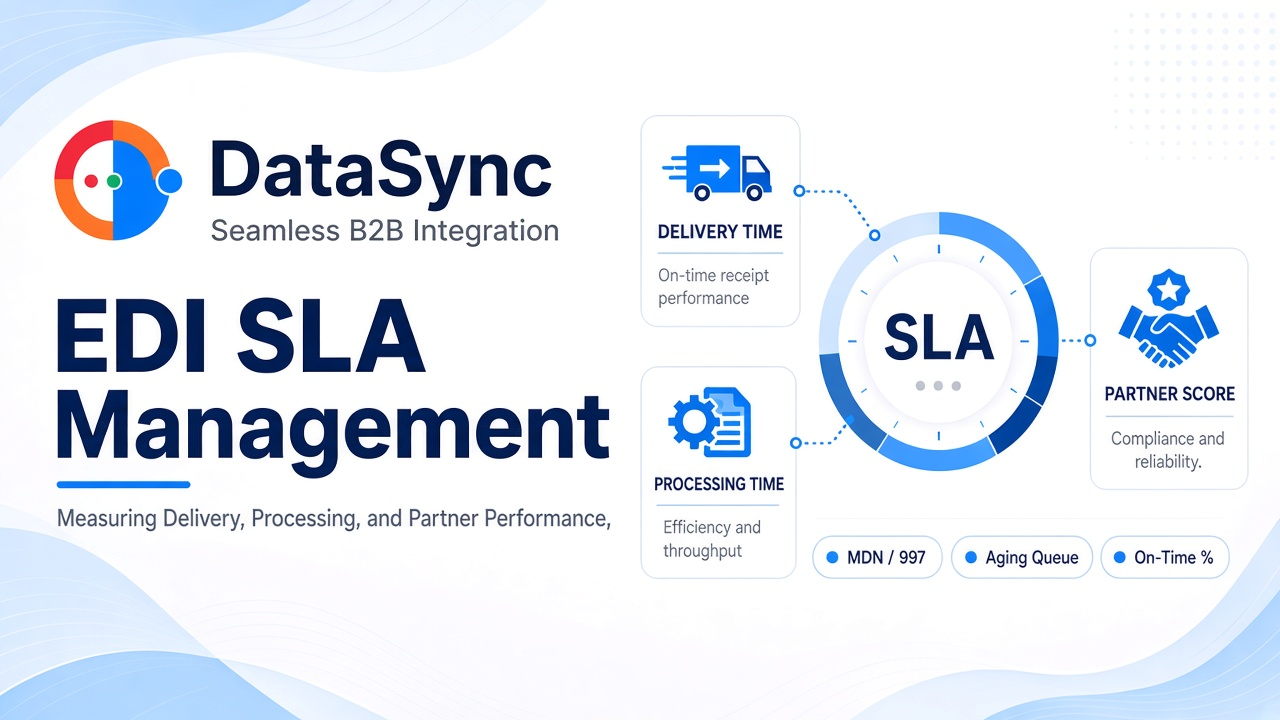
EDI SLA Management: Measuring Delivery, Processing, and Partner Performance
- DataSync
- 26 Sep, 2026
- 03 Mins read
- Edi
EDI SLAs are easy to write into a contract and hard to prove in production. “We sent it” is not the same as delivered, processed, or acknowledged on time.
SLA management is how enterprises measure those three clocks—delivery, processing, and partner response—so performance reviews use timestamps, not memory.
Define the Clocks Before You Score Anyone
An SLA only works if both sides agree when the clock starts and stops.
Typical enterprise clocks include:
- Delivery: file sent to MDN received, or SFTP drop to pickup confirmed
- Processing: inbound received to validated, mapped, and posted
- Acknowledgment: interchange received to 997/999 or application advice returned
- Partner response: reject or exception sent to corrected file received
If start and stop events are fuzzy, every miss becomes a debate.
Measure Delivery Separate From Processing
A late order is not always a late partner.
Delivery SLAs cover transport: AS2 retries, mailbox delays, certificate failures, and endpoint downtime. Processing SLAs cover what happens after the file lands: validation, mapping, routing, and ERP write.
Mixing them hides the real owner. Connectivity can be green while mapping is hours behind—or the reverse.
Put Acknowledgments on the Scorecard
Acknowledgments are the shared proof that both sides saw the same transaction.
Track:
- Time to MDN for AS2 exchanges
- Time to functional 997/999
- Time to application-level accept or reject
- Open interchanges with no acknowledgment past the SLA window
A partner that “always sends” but rarely acknowledges on time is not meeting the relationship, even if volume looks healthy.
Score Partners on Patterns, Not Single Files
Enterprises should roll SLAs up by partner and transaction set.
Useful partner measures:
- On-time delivery and on-time acknowledgment percentage
- Average and 95th-percentile processing time
- Exception rate and repeat-reject rate
- Aging volume still open past SLA
- Time to recover after a failure
One late 856 is an incident. A month of late ASNs is a partner-performance problem.
Make SLAs Visible in the Same Place as the Work
A weekly spreadsheet is too late for operational SLAs.
Ops teams need live views of what is approaching a breach, what already missed, and who owns the next action. Link each clock to the transaction, control numbers, and exception record so a miss can be investigated without rebuilding the timeline.
Visibility turns SLA management into prevention instead of month-end argument.
Use SLAs to Improve, Not Only to Penalize
The point is not a red dashboard.
When delivery, processing, and partner clocks are measured the same way every time, teams can fix maps, rotate certificates before they expire, renegotiate unrealistic windows, and drop partners who consistently miss.
That is how SLA management becomes an operating system for EDI—not a clause nobody can prove.
Final Takeaway
EDI SLA management measures delivery, processing, and partner performance as separate clocks with clear start and stop events, acknowledgment proof, and partner-level scorecards.
When those measures live next to the work, enterprises stop arguing about who was late and start shortening the time that actually matters.
Our Team Members