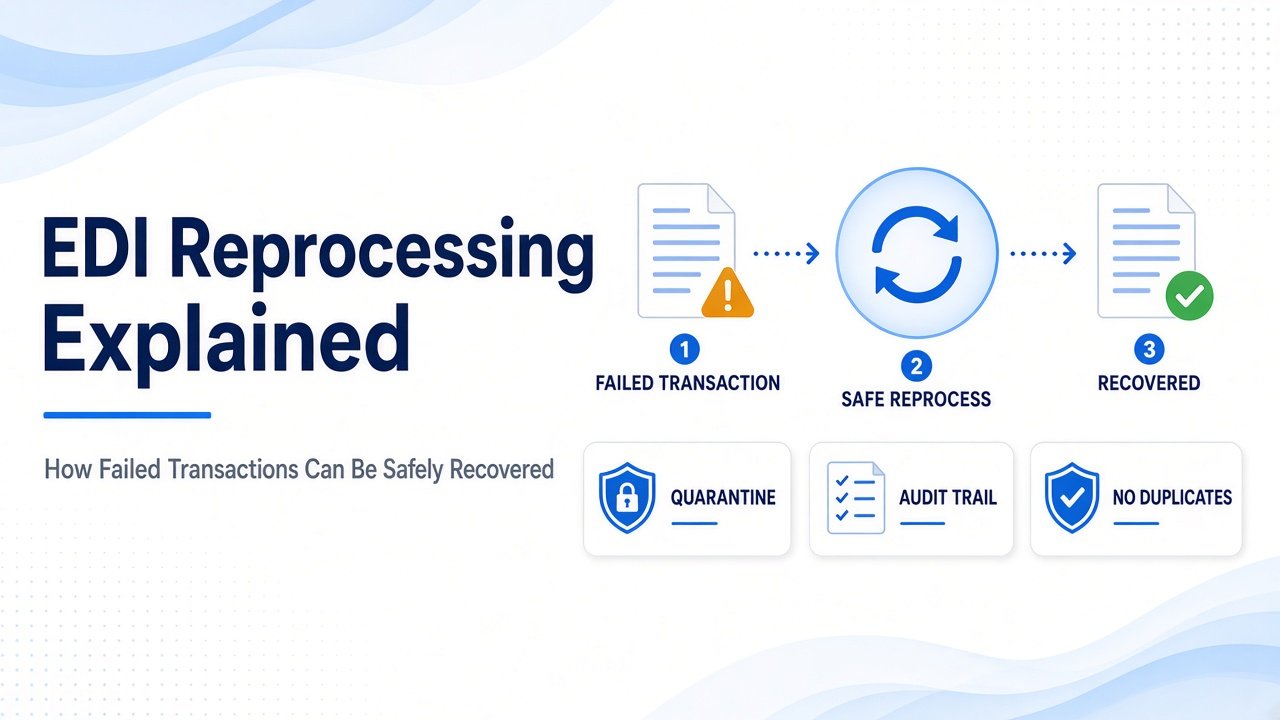
EDI Reprocessing Explained: How Failed Transactions Can Be Safely Recovered
- DataSync
- 21 Sep, 2026
- 03 Mins read
- Edi
Failed EDI transactions are inevitable. Partners send bad data, certificates expire, maps reject segments, ERP posts time out, and acknowledgments never return. The difference between a controlled operation and a scramble is whether those failures can be recovered safely.
EDI reprocessing is the disciplined replay of a failed transaction—without duplicating business results or losing the audit trail.
Know Where the Failure Happened
Safe recovery starts with knowing the failure stage.
Typical break points include:
- Transport issues such as AS2 or SFTP delivery problems
- Syntax or schema validation rejects
- Mapping and enrichment errors
- Routing or partner-profile mismatches
- ERP or downstream write failures
- Missing MDN, 997, or application acknowledgment
Reprocessing a mapping error is different from replaying a successful ERP post that only failed acknowledgment. Treat them as separate recovery paths.
Quarantine First, Replay Second
Do not leave failed files in an ambiguous state.
A strong reprocessing flow:
- Captures the original payload as received
- Marks the transaction as failed with a clear reason code
- Quarantines it so it cannot silently re-enter production
- Preserves partner, control numbers, and timestamps for support
Quarantine turns failures into managed work items instead of mystery files in a mailbox.
Replay From the Right Checkpoint
Blind “run it again” is how double orders and double invoices happen.
Safe reprocessing chooses the earliest correct checkpoint:
- If transport failed, resend or wait for partner resend
- If validation failed, fix data or rules, then revalidate
- If mapping failed, correct the map and transform again
- If ERP posting failed, retry the business write with idempotency checks
- If only the acknowledgment failed, confirm state before sending another 997 or MDN
The goal is recovery from the last known good step—not restarting the entire pipeline by default.
Guard Against Duplicate Side Effects
Every reprocess must assume the first attempt may have partially succeeded.
Before writing again, the platform should check:
- Trading partner and transaction identity
- Interchange and group control numbers
- Business document keys such as PO, invoice, or shipment ID
- Whether ERP already accepted the document
If the business effect already landed, mark the recovery as complete and close the acknowledgment loop—do not create a second transaction.
Keep Humans in the Loop for High-Risk Cases
Not every failure should auto-retry.
High-risk cases—large invoice amounts, first-time partners, repeated rejects, or data that looks altered—need operator review. Ops should see the original error, the proposed fix, and the expected outcome before approving replay.
Automation speeds recovery. Human approval protects the business when stakes are high.
Close the Loop With Visibility and Acknowledgments
A reprocessed transaction is not done until both sides share the same status.
Tracking should show the original failure, the reprocess attempt, the final success or reject, and linked acknowledgments. Partners and internal teams should be able to answer: was this recovered, skipped as duplicate, or still open?
Without that visibility, support teams reprocess the same issue twice and create new noise.
Final Takeaway
EDI reprocessing recovers failed transactions safely by quarantine, checkpoint-based replay, duplicate guards, and clear acknowledgment status.
When recovery is controlled, operations stop firefighting individual files and start resolving exceptions with confidence.
Our Team Members