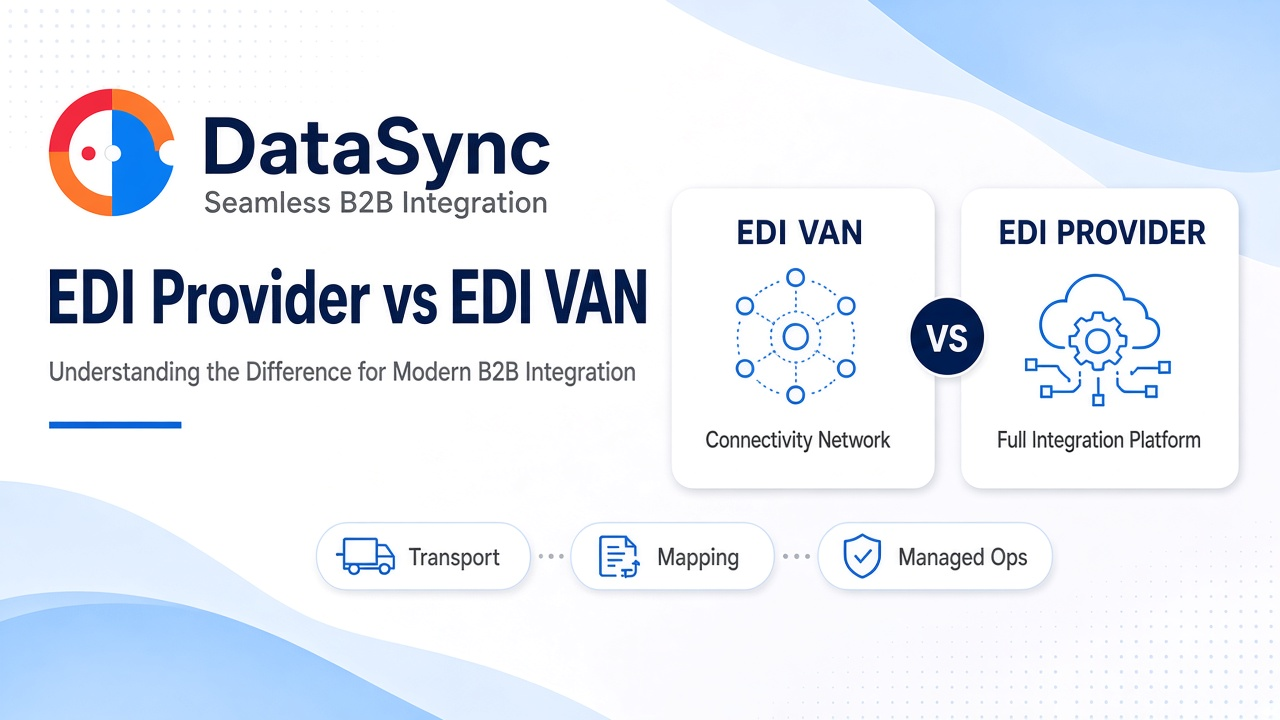
EDI Provider vs EDI VAN: Understanding the Difference for Modern B2B Integration
- DataSync
- 29 Sep, 2026
- 03 Mins read
- Edi
Teams often use “EDI VAN” and “EDI provider” as if they mean the same thing. They do not.
A VAN moves documents between trading partners. An EDI provider usually owns more of the operating stack—connectivity, mapping, monitoring, and exception handling. Knowing the difference keeps buying decisions honest.
What an EDI VAN Actually Does
A Value-Added Network is a shared mailbox and routing layer.
Partners send and receive EDI through the VAN instead of connecting directly. The VAN handles store-and-forward delivery, partner addressing, and often basic delivery reporting.
That is valuable. It is also limited. A classic VAN does not automatically own your maps, ERP posting, duplicate detection, or ops queue. It is primarily a transport and interchange network.
What a Modern EDI Provider Covers
An EDI provider is built for the full exchange lifecycle.
Beyond delivery, providers typically include:
- Partner onboarding and profile management
- AS2, SFTP, API, and sometimes VAN connectivity
- Mapping and validation to partner and ERP formats
- Acknowledgments such as MDN and 997
- Monitoring, exceptions, reprocessing, and audit trails
In short: a provider is a platform for running EDI operations, not only a pipe for moving files.
The Practical Difference in Day-to-Day Work
With a VAN-first setup, your team still needs somewhere to translate documents, fix rejects, and prove what happened.
With a provider-first setup, those jobs sit in one place:
- Routing decides where a document goes
- Maps transform it for the partner or ERP
- Monitoring shows delivery and processing status
- Exceptions become assigned work, not mailbox archaeology
If your pain is “we cannot connect,” a VAN may be enough. If your pain is “we cannot operate,” you need provider capabilities.
Why the Lines Get Blurry
Many VANs now sell mapping, portals, and managed services. Many EDI providers still interconnect with VANs for partners who require them.
So the market label is less useful than the capability checklist:
- Who owns transport only?
- Who owns maps and versioning?
- Who owns acknowledgments and SLA visibility?
- Who owns failed-transaction recovery?
- Who your ops team calls when production breaks?
Buy the operating model you need, not the legacy acronym.
How Modern B2B Teams Should Choose
Choose VAN-centric connectivity when partners mandate a specific network and your internal stack already handles mapping and ops well.
Choose an EDI provider when you want one system for partner setup, document processing, monitoring, and support—especially across many partners, protocols, and ERP destinations.
Many enterprises use both: provider as the control plane, VAN as one of several transport paths.
Final Takeaway
An EDI VAN is a network for exchanging documents. An EDI provider is a platform for running B2B integration end to end.
Modern teams win when they separate connectivity from operations—and pick a model that covers the work they actually do after the file leaves the mailbox.
Our Team Members