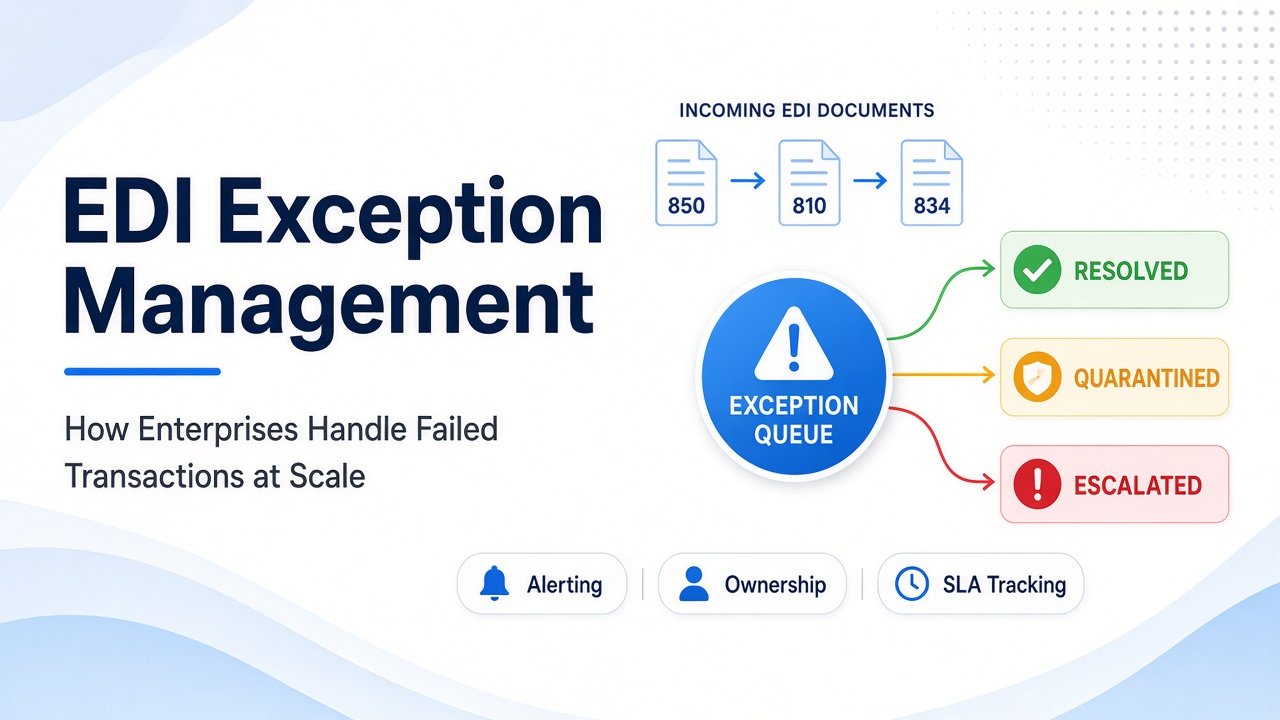
EDI Exception Management: How Enterprises Handle Failed Transactions at Scale
- DataSync
- 24 Sep, 2026
- 03 Mins read
- Edi
At low volume, a failed EDI file is a one-off. At enterprise scale, failures arrive every hour: bad data, expired certificates, mapping rejects, missing acknowledgments, and ERP timeouts.
Exception management is how operations teams turn those failures into a controlled queue—not an inbox full of unexplained tickets.
Treat Exceptions as Work Items, Not Log Lines
A failed transaction is not done when it hits an error log.
Each exception needs:
- The original payload and partner identity
- The failure stage (transport, validation, mapping, routing, or ERP)
- A reason code the team can act on
- A status such as new, assigned, waiting on partner, or resolved
- An owner and a due time
If the only record is a stack trace, scale just multiplies the noise.
Separate Noise From Real Exceptions
Not every retry or warning deserves a human.
Enterprises stay sane by classifying inbound events:
- Auto-recoverable: transient timeouts, brief mailbox delays
- Duplicate or already processed: skip with an audit note
- Partner-fixable: missing segments, wrong IDs, test flag in production
- Internal-fixable: map bugs, routing gaps, certificate rotation
- Escalation: high-value invoices, first-time partners, repeated rejects
The queue should show work that needs a decision. Everything else should close automatically with a visible reason.
Route by Failure Type, Not by Who Yelled First
Scale breaks when every exception goes to the same person.
A workable model assigns:
- Transport and certificate failures to connectivity
- Validation and map rejects to EDI analysts
- ERP posting failures to integration or application owners
- Partner data issues to the partner contact path
- SLA breaches to an on-call escalation
Clear routing stops exceptions from bouncing between EDI, IT, and the trading partner with no owner.
Put SLAs on the Queue
Enterprises do not only ask “what failed.” They ask “how old is it, and what is at risk.”
Useful controls include:
- Time-to-triage for new exceptions
- Time-to-partner-contact for data rejects
- Time-to-recover for orders and invoices that block shipment or payment
- Aging views by partner, transaction set, and failure type
Without SLAs, high-volume partners drown the queue while a single blocked 850 sits unnoticed.
Keep the Partner in the Same Thread
Many exceptions cannot be fixed internally.
The original file, control numbers, reject reason, and related 997, 824, or MDN should travel with the case. That lets support send one precise question instead of asking the partner to “resend the file.”
When partner replies stay attached to the same exception, teams do not reprocess the same failure twice.
Close the Loop, Then Look for Patterns
Resolution is not only “file processed.”
A closed exception should record the fix, whether a reprocess was needed, and whether the partner or the map changed. Then operations should roll those outcomes up: which partners generate the most rejects, which maps fail after a change, and which failure types keep returning.
That is how exception management becomes prevention—not just faster firefighting.
Final Takeaway
EDI exception management at scale is a queue with ownership, classification, SLAs, and a partner trail—not a pile of error emails.
When failed transactions are visible, assigned, and closed with a reason, enterprises recover faster and spend less time rediscovering the same break.
Our Team Members