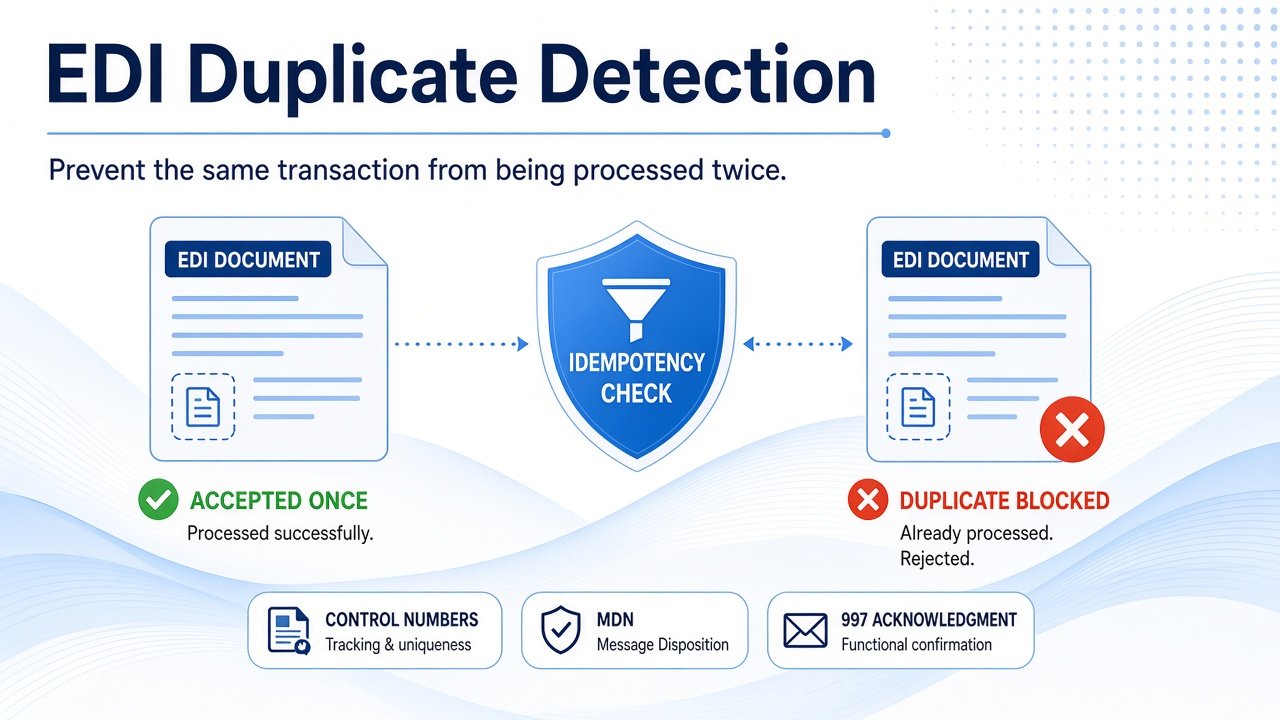
EDI Duplicate Detection: How to Prevent the Same Transaction from Being Processed Twice
- DataSync
- 19 Sep, 2026
- 03 Mins read
- Edi
Duplicate EDI transactions create real business damage: double POs, repeated invoices, duplicate shipments, and chargebacks that are hard to unwind. The root cause is rarely malice—it is retries, partner resends, overlapping mailboxes, or missing idempotency checks.
Duplicate detection is how modern EDI platforms make sure a transaction is processed once, even when the same file arrives more than once.
Why Duplicates Happen
Most duplicates are operational, not intentional.
Common triggers include:
- Partner resends after a timeout or missing MDN
- AS2 or SFTP retries when the first attempt actually succeeded
- Manual reprocessing without a “already processed” guard
- Split or overlapping mailbox pickup windows
- Multiple maps writing the same business document into ERP
If your platform only checks “did the file land,” it will still process the same business event twice.
Define What “Same Transaction” Means
Duplicate detection needs a clear identity key.
Useful keys usually combine:
- Trading partner ID
- Transaction set (850, 810, 856, and others)
- Interchange and group control numbers
- Document-level identifiers (PO number, invoice number, shipment ID)
- Optional content hash for exact payload matches
A strong rule is: same partner + same business document identity within a defined window = duplicate.
Detect Early, Before Mapping and ERP Posting
The safest place to catch duplicates is during validation—before mapping, routing, or ERP write.
At that stage, the platform should:
- Extract identity keys from the inbound payload
- Compare against a processed-transaction store
- Accept, quarantine, or reject based on policy
- Preserve the original file for audit and partner proof
Waiting until after ERP posting makes cleanup expensive.
Treat Retries as First-Class Traffic
Retries are normal in EDI. Duplicate detection must assume they will happen.
When a partner resends because they never saw an MDN, 997, or application acknowledgment, your system should recognize the second payload as the same transaction and return a clear duplicate outcome—not create a second order or invoice.
Close the Loop With Acknowledgments
Acknowledgments reduce accidental resends when they are timely and visible.
If partners can see successful receipt and acceptance quickly, they are less likely to push the same file again. Tracking should link the original interchange to its 997/999 or application advice so both sides share one truth.
Make Duplicate Outcomes Actionable
Ops teams need more than a silent skip.
A useful duplicate workflow shows:
- Which key matched
- When the original was processed
- Whether the new file is an exact payload match or a business-key match
- Whether to quarantine, reject, or notify the partner
- Who owns follow-up
Clear duplicate status turns noise into a controlled exception.
Final Takeaway
EDI duplicate detection prevents the same transaction from being processed twice by defining identity keys, checking them before ERP posting, treating retries as expected, and tying outcomes to acknowledgments.
When duplicates are stopped early, EDI operations stay clean—and finance, warehouse, and customer teams avoid costly reverse work.
Our Team Members