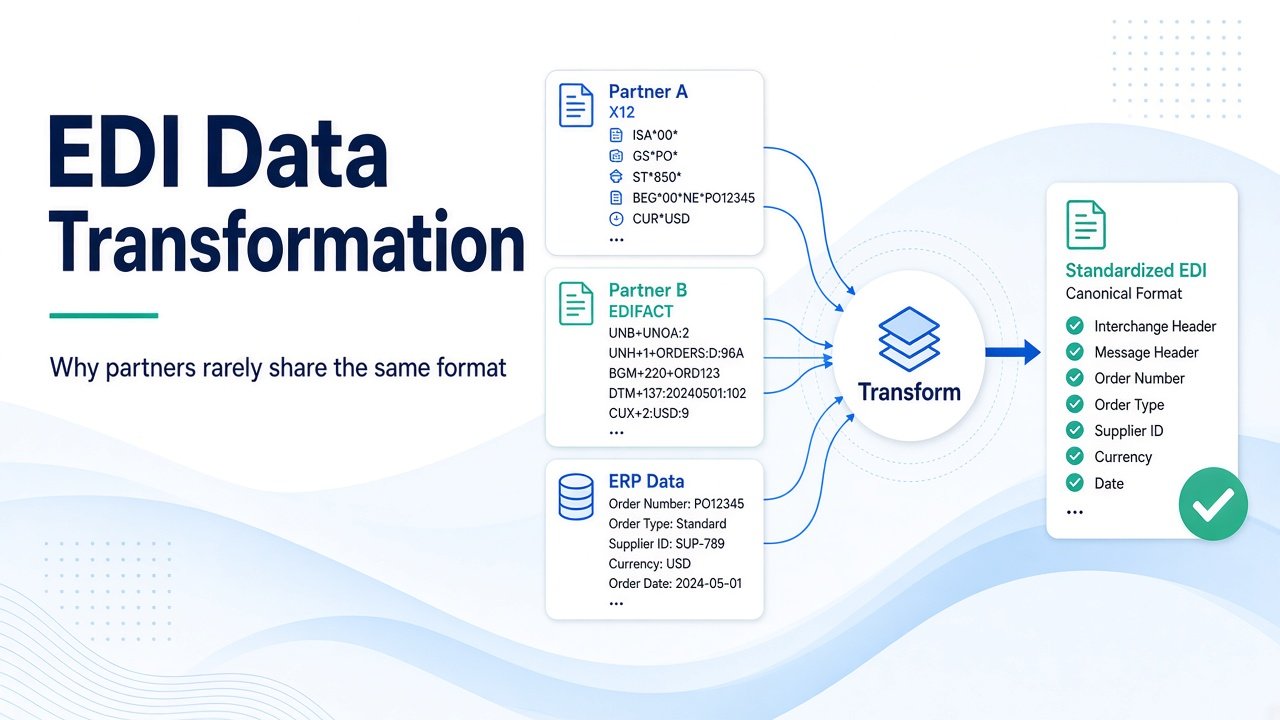
EDI Data Transformation: Why Trading Partners Rarely Use the Same Data Format
- DataSync
- 17 Sep, 2026
- 02 Mins read
- Edi
Trading partners rarely exchange data in the same format. One retailer may require ANSI X12 850 purchase orders with strict pack hierarchy. Another may expect different segment usage, code lists, or even EDIFACT. A supplier’s ERP may store the same business facts in completely different field names and structures.
EDI data transformation is what makes those mismatched formats work together.
Partners Optimize for Their Own Systems
Each company designs data around its ERP, WMS, TMS, or finance process—not around a universal partner schema.
That means the same business event can look different across systems:
- Item identifiers may be GTIN, vendor SKU, buyer item, or internal part number
- Quantities may use cases, eaches, or pallets
- Addresses may include location codes, DUNS, or GLN values
- Dates may follow partner-specific formats and business calendars
Transformation converts each partner’s required structure into something your systems can process—and the reverse on outbound documents.
Standards Still Leave Room for Variation
Even when partners agree on X12 or EDIFACT, they rarely implement them identically.
Companion guides define which segments are mandatory, which qualifiers are allowed, how packs are nested, and when acknowledgments are expected. Two valid 856 ASNs can still fail each other’s validation if the map ignores those partner rules.
Standards create a shared language. Transformation applies the local dialect.
What Transformation Usually Includes
EDI transformation is more than renaming fields.
Typical steps include:
- Mapping ERP fields to X12 or EDIFACT elements
- Code and unit-of-measure conversion
- Conditional segment generation
- Default values for required partner fields
- Validation against partner-specific rules
- Envelope and acknowledgment handling
Without those steps, documents may leave your system looking complete and still get rejected downstream.
Why One Map Per Partner Is Common
Because requirements differ, teams usually maintain partner-specific maps or map variants.
A shared canonical model can reduce duplication, but the last mile still depends on each trading partner’s guide. Trying to force one format onto every partner usually increases exceptions, chargebacks, and manual rework.
Transformation Quality Shows Up in Operations
Strong transformation reduces failed 997 responses, missing ASNs, invoice disputes, and support tickets.
Weak transformation creates silent data loss: wrong ship-from locations, truncated references, mismatched totals, or incomplete pack structures. Those issues are expensive because they surface after the document has already entered a partner workflow.
Final Takeaway
Trading partners rarely use the same data format because each system and companion guide reflects different business rules.
EDI data transformation exists to bridge those differences reliably—so purchase orders, ship notices, and invoices keep moving even when every partner speaks a slightly different dialect of EDI.
Our Team Members