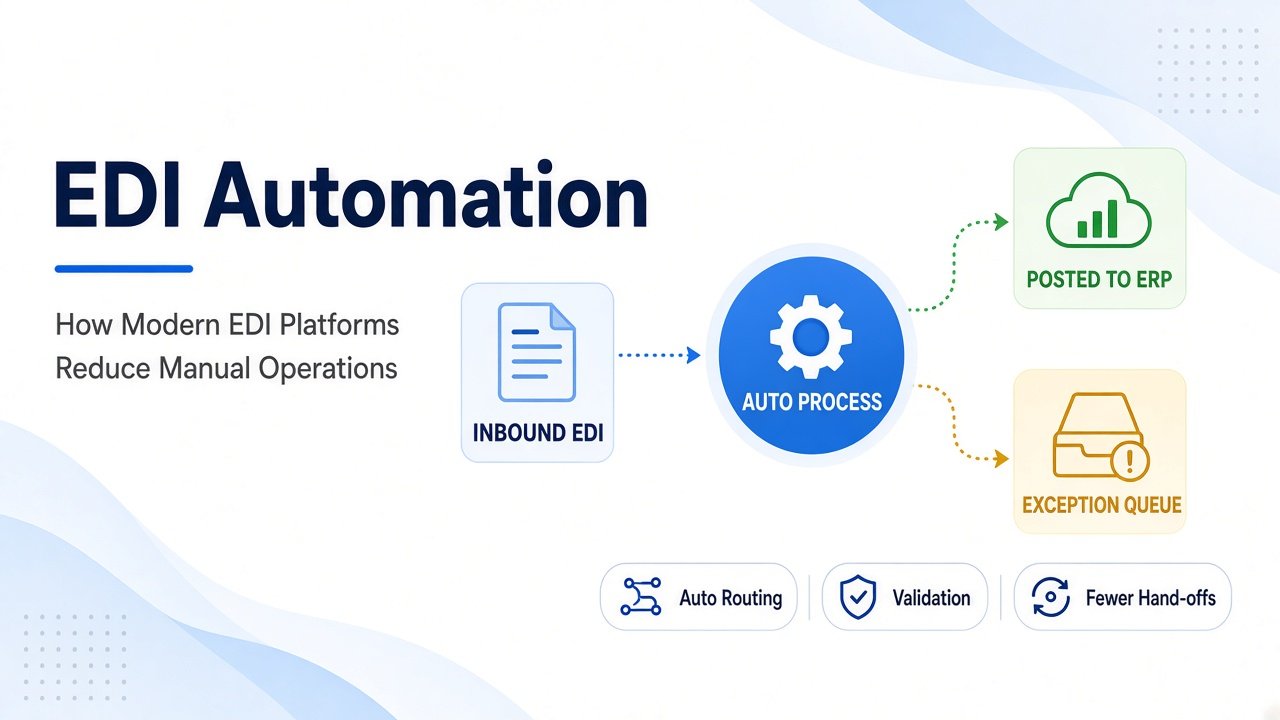
EDI Automation: How Modern EDI Platforms Reduce Manual Operations
- DataSync
- 28 Sep, 2026
- 03 Mins read
- Edi
Most EDI cost is not the file itself. It is the people who pick up mailboxes, rename documents, chase missing 997s, re-run maps, and email partners when something fails.
Modern EDI platforms reduce that labor by automating the path a healthy transaction should take—and isolating the exceptions that still need a human.
Automate the Happy Path First
Manual operations survive where the default flow still needs a person.
A modern platform should, without an operator:
- Receive the file over AS2, SFTP, or API
- Identify the partner and transaction set
- Validate the envelope and content
- Route to the right map
- Post or deliver downstream
- Send or match acknowledgments
If those steps still depend on a shared inbox, volume will always hire more people.
Replace Mailbox Watching With Routing Rules
The oldest manual job in EDI is “check the folder.”
Automation uses partner profiles and routing rules instead: sender ID, transaction type, environment, and destination decide where the file goes. Operators stop moving documents by hand and only see traffic that did not match a rule.
That shift is where headcount actually drops.
Let Validation and Mapping Run Without a Ticket
A large share of daily work is reprocessing files that should have been caught or transformed automatically.
Platforms cut that load when validation runs at intake, maps are versioned per partner, and known-good documents post without a queue. People stay involved for rule changes and true data defects—not for every 850 that arrived on time.
Close Acknowledgments Automatically
Chasing MDNs and 997s is classic manual EDI.
Automation links each interchange to its acknowledgment, retries when the protocol allows it, and opens an exception only when the window is missed. Support stops asking “did they get it?” for files the system already proved.
Keep Humans on Exceptions, Not Every File
Automation is not “no people.” It is fewer people on the wrong work.
Operators should handle:
- Partner data that fails validation
- Map gaps after a partner change
- Certificate and endpoint failures
- High-risk reprocessing approvals
- SLA breaches and escalations
Everything else should complete in the background with an audit trail.
Automate Onboarding Where It Repeats
Manual operations also hide in setup: new partner, new IDs, new test cycles, same checklist.
Modern platforms reuse partner-profile templates, standard test packs, and certificate workflows so onboarding is configuration, not a custom project every time. That is how automation scales relationships, not only transactions.
Final Takeaway
EDI automation reduces manual operations by running intake, routing, validation, mapping, and acknowledgments without a hand-off—and by sending only true exceptions to people.
When the happy path is automatic, operations teams stop babysitting files and start managing the partners and rules that still need judgment.
Our Team Members