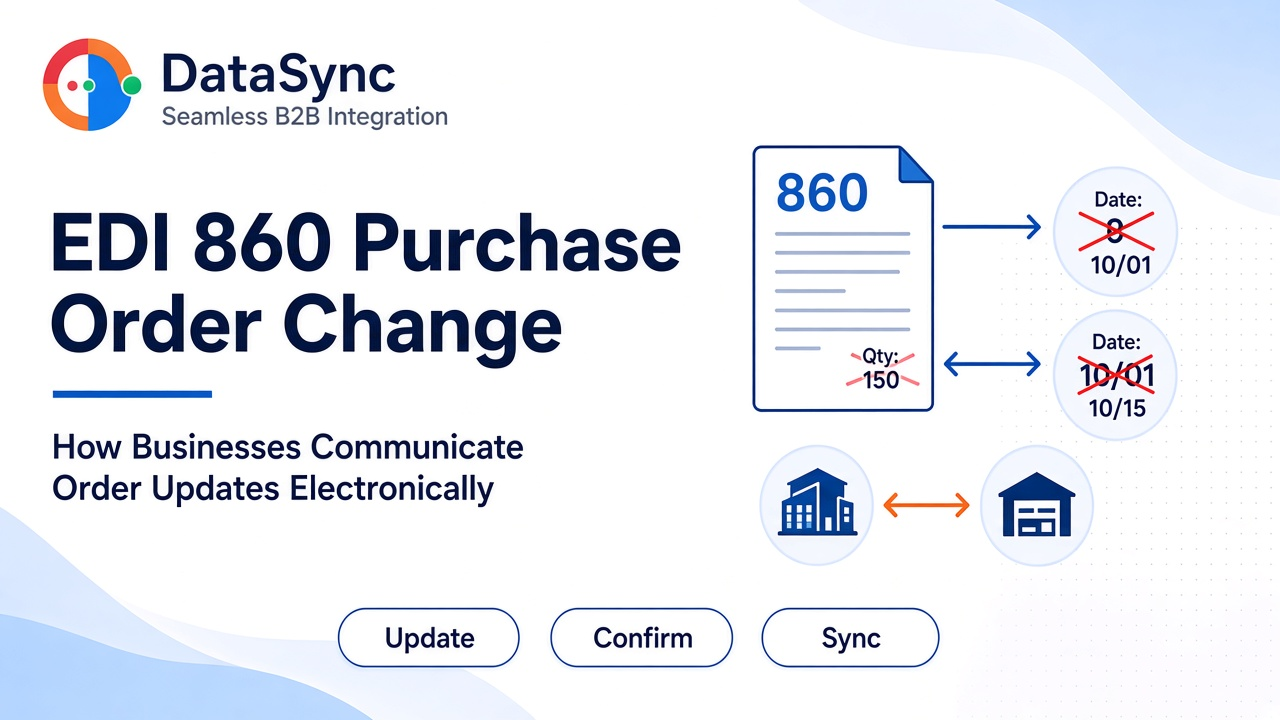
EDI 860 Purchase Order Change: How Businesses Communicate Order Updates Electronically
- DataSync
- 08 Oct, 2026
- 03 Mins read
- Edi
The EDI 860 Purchase Order Change is the electronic document a buyer sends to update an existing purchase order after the original EDI 850 was issued. It is how businesses communicate quantity changes, date shifts, line cancels, and other order revisions without relying on email threads.
In live supply chains, orders rarely stay frozen. The 860 is the controlled way to keep buyer and supplier systems on the same revised plan.
What Is an EDI 860?
The EDI 860 is an ANSI X12 transaction set used to communicate changes to a previously transmitted purchase order.
A typical 860 can update:
- Order quantities
- Requested ship or delivery dates
- Line item additions, changes, or cancellations
- Prices or terms when allowed by the partner agreement
- Ship-to or other reference data
- Overall order cancel or close indicators
The 860 should always point back to the original PO number so downstream systems revise the same order, not create a duplicate.
Why Purchase Order Changes Matter
Demand, inventory, and logistics shift constantly. Without electronic change control:
- Suppliers keep fulfilling outdated quantities or dates
- Warehouses pick against stale open orders
- ASNs and invoices drift from what the buyer still needs
- Teams resolve conflicts in inboxes instead of systems of record
A clean 860 process protects both sides from shipping—or paying for—the wrong version of an order.
How Businesses Communicate Order Updates Electronically
A common flow looks like this:
- Buyer issues an 850 to place the original order.
- Supplier may acknowledge with an 855.
- Business conditions change—forecast, inventory, store need, or carrier capacity.
- Buyer sends an 860 with the revised order details.
- Supplier validates and applies the change in ERP/OMS.
- Supplier may re-acknowledge (often via another 855) depending on partner rules.
- Fulfillment continues toward 856 and 810 based on the updated order.
The key is one shared PO identity across original and change documents.
Key Data Teams Should Watch on Every 860
Order management and EDI teams usually focus on:
- PO reference integrity — change applies to the correct original order
- Line correlation — changed lines map to existing PO lines cleanly
- Change purpose — quantity, date, cancel, or replace is explicit
- Timing — changes arrive before pick/pack/ship locks the old plan
- Partner rules — which fields are allowed to change after acknowledgment
- Version control — systems do not process an outdated change after a newer one
Late 860s against already-shipped lines create avoidable disputes.
How the 860 Connects to 850, 855, 856, and 810
- 850 creates the baseline order
- 860 revises that baseline
- 855 confirms supplier response to the current order state
- 856 / 810 should reflect the latest agreed fulfillment outcome
If shipment and invoice data ignore accepted changes, the process broke between order management and warehouse/billing.
Common EDI 860 Problems
Teams frequently see:
- Changes sent by email while EDI still holds the old 850
- 860s that add lines without required partner codes
- Quantity decreases after inventory is already allocated or picked
- Date changes that miss the supplier’s cutoff window
- Missing acknowledgments after material order revisions
- Duplicate or out-of-sequence change documents
Treat order changes as controlled events: validate, apply, acknowledge, and freeze fulfillment against the latest accepted version.
Final Takeaway
The EDI 860 Purchase Order Change is how businesses communicate order updates electronically after the original PO. When changes are timely, referenced correctly, and confirmed by both sides, fulfillment stays aligned with real demand.
If order updates still live in email while the 850 remains untouched in EDI, your systems are fulfilling a document that is no longer true.
Our Team Members