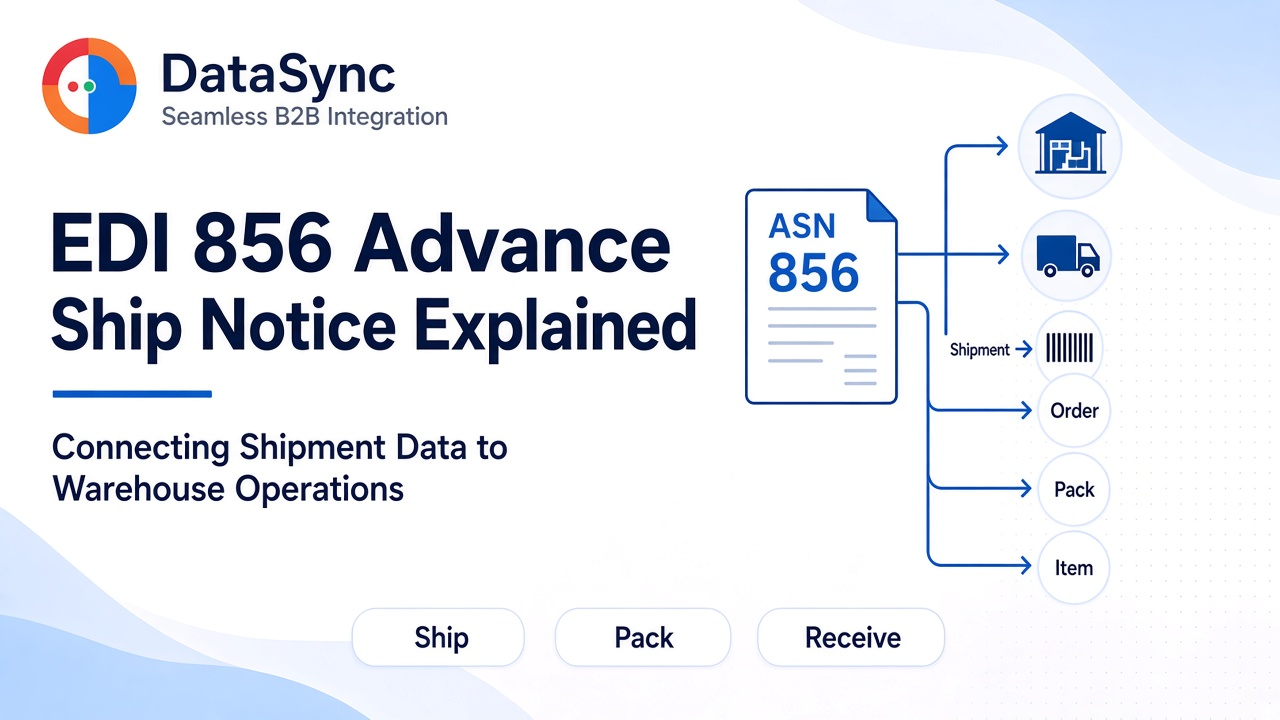
EDI 856 Advance Ship Notice Explained: Connecting Shipment Data to Warehouse Operations
- DataSync
- 05 Oct, 2026
- 03 Mins read
- Edi
The EDI 856 Advance Ship Notice (ASN) is the electronic document a supplier sends to describe a shipment before—or as—it leaves the dock. For warehouse and receiving teams, it is the bridge between “order confirmed” and “freight arrives.”
A strong ASN lets DCs plan labor, dock doors, and putaway before the truck shows up. A weak ASN creates receiving delays, label mismatches, and retail chargebacks.
What Is an EDI 856?
The EDI 856 is an ANSI X12 transaction set used to communicate shipment content and structure in a standardized format.
A typical ASN includes:
- Shipment identification and ship date
- Carrier and tracking or PRO references
- Purchase order numbers tied to the load
- Hierarchical packing detail (shipment, order, pack/carton, item)
- Item quantities and identifiers
- Ship-from and ship-to locations
- Weight, cube, and packaging references when required
Unlike a simple status email, the 856 is designed so warehouse systems can pre-build receipts against expected cartons and lines.
Why the EDI 856 Matters for Warehouse Operations
Warehouses run on timing and accuracy. The ASN is how shipment data arrives early enough to be useful.
When ASNs are complete and on time:
- Receiving can schedule appointments against known volume
- Scan processes match carton labels to expected contents
- Cross-dock and flow-through moves start faster
- Inventory updates closer to physical receipt
- Buyer and supplier disputes shrink because both sides share one shipment record
When ASNs are late, missing hierarchy, or out of sync with labels, docks slow down and exceptions pile up.
How Shipment Data Connects to the Warehouse
A common path looks like this:
- Order is placed and confirmed via 850 and often 855.
- Supplier picks and packs against the confirmed PO lines.
- ASN is generated from WMS/ERP with carton and item detail.
- 856 is transmitted over AS2, SFTP, API, or VAN before or at ship time.
- Buyer WMS ingests the ASN and creates an expected receipt.
- Freight arrives and teams scan cartons against the ASN structure.
- Exceptions are worked—shorts, overages, mis-ships—before inventory is finalized.
- Invoice follows with an 810, ideally aligned to what shipped and received.
The ASN is the operational handshake between supplier fulfillment and buyer receiving.
Key Data Teams Should Watch on Every 856
Warehouse and EDI teams usually focus on:
- PO correlation — shipment lines map to open purchase orders
- Hierarchy integrity — shipment → order → pack → item structure matches labeling
- Item identity — SKUs/UPCs match the catalog and original order
- Quantities — packed qty vs ordered qty differences are intentional and visible
- Carrier detail — enough data for appointment, track-and-trace, and yard control
- Timing — partner SLA for ASN lead time before arrival
Most ASN chargebacks come from structure and label mismatches, not from “EDI transport failure.”
How the 856 Connects to 850, 855, and 810
- 850 defines what was ordered
- 855 confirms what the supplier intends to fulfill
- 856 reports what is physically shipping
- 810 bills for the commercial outcome of that shipment
If the ASN routinely disagrees with the acknowledgment or invoice, the issue is process control across systems—not a single document type.
Common EDI 856 Problems
Teams frequently see:
- ASNs sent after the truck arrives
- Flat ASNs that omit carton/pack hierarchy required by the DC
- Carton labels that do not match ASN SSCC or pack IDs
- Quantities that change after transmission without a corrected ASN
- Multiple POs on one load without clear shipment grouping
- Missing ship-to or department codes that break retail compliance
Validate ASNs against partner guides before they leave—and age inbound ASNs that never arrive.
Final Takeaway
The EDI 856 Advance Ship Notice connects shipment data to warehouse operations. When it is timely, hierarchical, and tied to the original order, receiving becomes a scan-and-confirm process instead of a discovery exercise.
If your team treats the ASN as optional paperwork, the dock will keep paying for that choice in labor, delays, and partner penalties.
Our Team Members