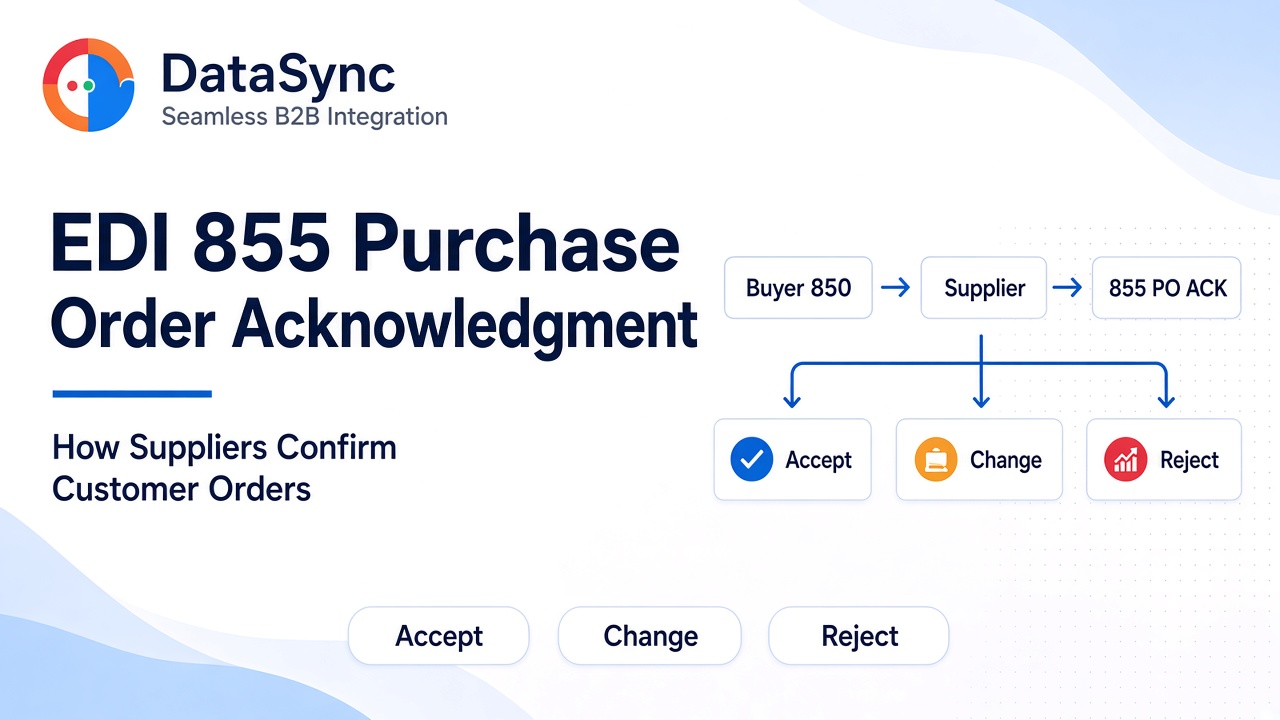
EDI 855 Purchase Order Acknowledgment: How Suppliers Confirm Customer Orders
- DataSync
- 03 Oct, 2026
- 03 Mins read
- Edi
The EDI 855 Purchase Order Acknowledgment is the supplier’s formal response to an EDI 850 purchase order. It tells the buyer whether the order was accepted, changed, or rejected—before goods move and before invoices are created.
For operations teams, the 855 is early warning: it surfaces inventory gaps, date conflicts, and line-level changes while there is still time to fix the plan.
What Is an EDI 855?
The EDI 855 is an ANSI X12 transaction set used to acknowledge a purchase order in a structured electronic format.
A typical 855 communicates:
- The related purchase order number
- Overall order status (accepted, rejected, or accepted with changes)
- Line-level accept, reject, or change details
- Confirmed quantities and units of measure
- Confirmed or revised dates
- Item identifiers and partner references
Without a clear 855, buyers often assume the original 850 will ship as ordered—until an ASN or invoice proves otherwise.
Why the EDI 855 Matters
A purchase order is a request. An acknowledgment is a commitment signal.
When 855s are timely and accurate:
- Buyers update promises to stores, customers, or production
- Suppliers lock capacity against confirmed demand
- Exceptions are owned early instead of at ship time
- Chargebacks and missed SLAs from silent short-ships decline
When 855s are late, missing, or incomplete, both sides operate on different versions of the same order.
How Suppliers Confirm Customer Orders
A common flow looks like this:
- Buyer sends an 850 with requested items, quantities, and dates.
- Supplier receives and validates the PO (structure, duplicates, partner rules).
- Order management reviews availability—stock, lead time, substitutions, and ship capability.
- Supplier returns an 855 that accepts, changes, or rejects header and/or lines.
- Buyer systems update open order status from the acknowledgment.
- Fulfillment continues toward 856 ASN and 810 invoice based on what was actually confirmed.
The 855 sits between “order received” and “order executable.”
Accept, Change, and Reject—What Each Means
Suppliers typically respond in one of three ways:
- Accept — the PO (or line) can be fulfilled as requested
- Change — quantity, date, item, or terms must be revised before fulfillment
- Reject — the PO or line cannot be fulfilled under current conditions
Strong trading-partner guides define which change codes are allowed and how buyers should react to each status.
Key Data Teams Should Watch on Every 855
Operations and integration teams usually focus on:
- PO reference integrity — acknowledgment matches the original 850 control and PO number
- Line correlation — line numbers and item codes map cleanly back to the PO
- Status codes — accept/change/reject semantics match the partner guide
- Confirmed quantities and dates — differences from the 850 are explicit, not implied
- Timing SLAs — many buyers require an 855 within a fixed window after PO receipt
A technical 997/999 only proves the file was received. The 855 proves the business response.
How the 855 Connects to 850, 856, and 810
- 850 places the order
- 855 confirms what the supplier will (or will not) fulfill
- 856 reports what actually shipped
- 810 invoices what was billed under the confirmed/fulfilled terms
If the 855 and later ASN disagree often, the issue is usually process discipline—not just mapping.
Common EDI 855 Problems
Teams frequently see:
- Missing 855s after successful 850 delivery
- Header accepted while critical lines silently change
- Quantity or date changes without clear reason codes
- Acknowledgments that do not correlate to the original PO lines
- Buyer systems that ignore change statuses and keep the original promise dates
Treat the 855 as a control document: validate it, age late ones, and escalate unresolved changes.
Final Takeaway
The EDI 855 Purchase Order Acknowledgment is how suppliers confirm customer orders in electronic B2B networks. When it is sent on time, mapped to partner rules, and linked to the original 850, buyers and suppliers share one version of truth before fulfillment begins.
If your team only monitors whether the 850 arrived, you are missing the document that decides whether the order can actually ship.
Our Team Members