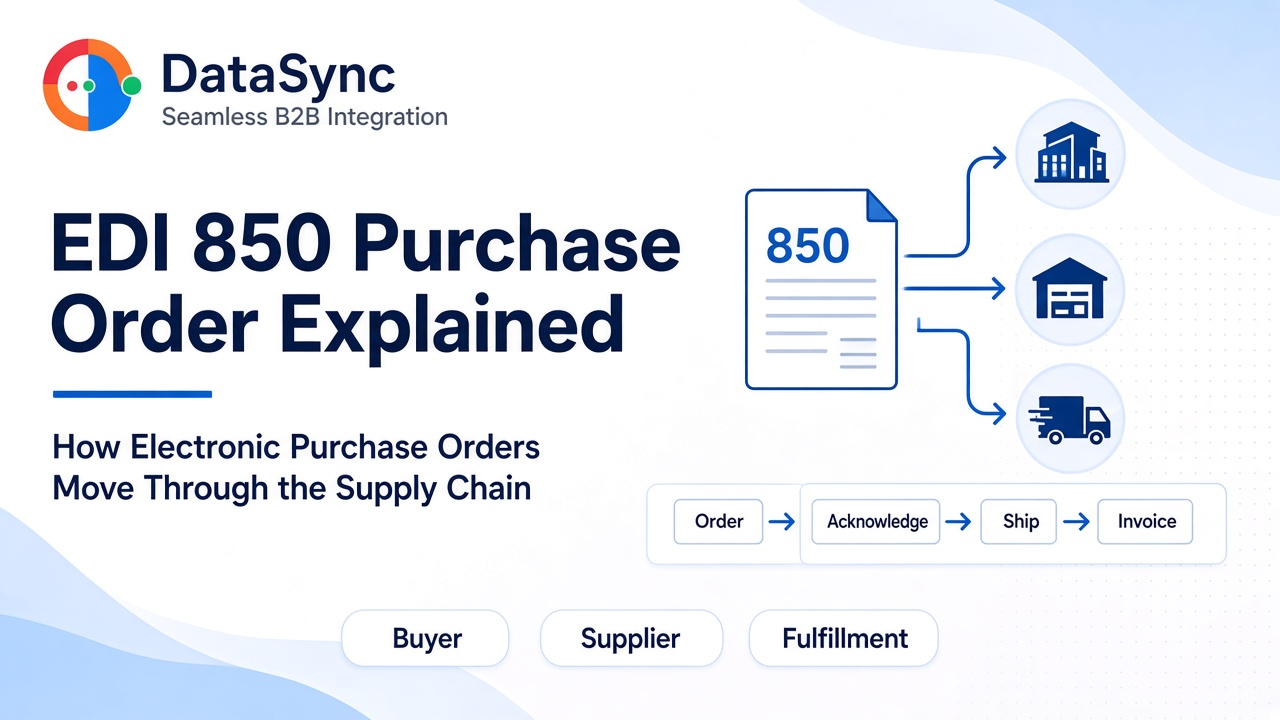
EDI 850 Purchase Order Explained: How Electronic Purchase Orders Move Through the Supply Chain
- DataSync
- 01 Oct, 2026
- 03 Mins read
- Edi
The EDI 850 Purchase Order is the electronic document a buyer sends to place an order with a trading partner. In most B2B networks, it is the starting point of the order-to-cash and procure-to-pay flow: once the 850 is accepted, fulfillment, shipping, and invoicing can begin.
Understanding the 850 matters because a weak PO—wrong items, bad quantities, missing dates, or partner-specific rule failures—creates exceptions that ripple through warehouses, carriers, and finance.
What Is an EDI 850?
The EDI 850 is an ANSI X12 transaction set used to communicate purchase order details in a structured format instead of email, portals, or paper.
A typical 850 includes:
- Purchase order number and order date
- Buyer and supplier identifiers
- Line items (SKU, UPC, or partner item codes)
- Quantities and units of measure
- Prices and currency
- Ship-to and bill-to locations
- Requested ship or delivery dates
- Partner-specific references (department, store, contract, or promotion codes)
Because each retailer or manufacturer may require different segments and codes, the “same” 850 can look different by trading partner.
Why the EDI 850 Matters in the Supply Chain
The 850 is not just a message file. It is the operational trigger that tells suppliers what to build, pick, pack, and ship.
When 850s arrive cleanly:
- Orders post into ERP or order management with less manual keying
- Inventory and capacity planning start earlier
- Acknowledgments and ASNs stay tied to a clear PO reference
- Chargeback risk from wrong ship-to, labels, or dates drops
When 850s fail validation or mapping, teams burn time on rejections, rework, and missed SLAs.
How an Electronic Purchase Order Moves End to End
A common supply-chain path looks like this:
- Buyer creates the order in ERP, procurement, or a planning system.
- EDI maps and validates the outbound 850 against the partner’s guide (segments, codes, envelopes).
- Transport delivers the document over AS2, SFTP, API, or a VAN.
- Supplier receives and validates the inbound 850 (structure, duplicates, business rules).
- Order posts into the supplier’s ERP or OMS for fulfillment.
- Acknowledgments confirm progress—often a 997/999 for technical receipt and an 855 for accept/reject/change.
- Fulfillment continues with an 856 ASN at ship time and an 810 invoice after shipment or delivery terms are met.
At each step, control numbers, PO numbers, and line references should stay linked so ops can trace one order from send to cash.
Key Data Teams Should Watch on Every 850
Operations and integration teams usually focus on:
- Partner identity — correct ISA/GS IDs and application receiver codes
- Item identity — buyer vs supplier part numbers mapped correctly
- Quantity and UOM — units that match the partner’s catalog
- Dates — requested ship vs delivery, and time-zone expectations
- Ship-to detail — store, DC, or drop-ship address completeness
- Price and terms — contract or catalog alignment to avoid invoice disputes later
Most preventable 850 failures come from partner-specific rules, not from “EDI being broken.”
How the 850 Connects to 855, 856, and 810
Think of the 850 as the order contract in electronic form:
- 855 answers the 850: accepted, rejected, or changed
- 856 reports what actually shipped against the PO
- 810 bills for what was fulfilled under the PO terms
If the original 850 is wrong or incomplete, every downstream document inherits the problem.
Common EDI 850 Problems
Teams frequently see:
- Duplicate purchase orders from retries without idempotency checks
- Missing or invalid store/DC codes
- Item codes that map in one partner profile but not another
- Date or UOM mismatches that pass syntax checks but fail business validation
- Late or missing 855 responses that leave fulfillment status unclear
Strong validation before ERP write—and clear exception ownership after failures—keeps the supply chain moving.
Final Takeaway
The EDI 850 Purchase Order is how electronic buying intent enters the supply chain. When it is mapped correctly, validated against partner rules, and tracked through acknowledgments and fulfillment documents, orders move with fewer surprises.
If your team still treats the 850 as “just a file,” start treating it as the control document for everything that follows: acknowledgment, shipment, invoice, and partner performance.
Our Team Members