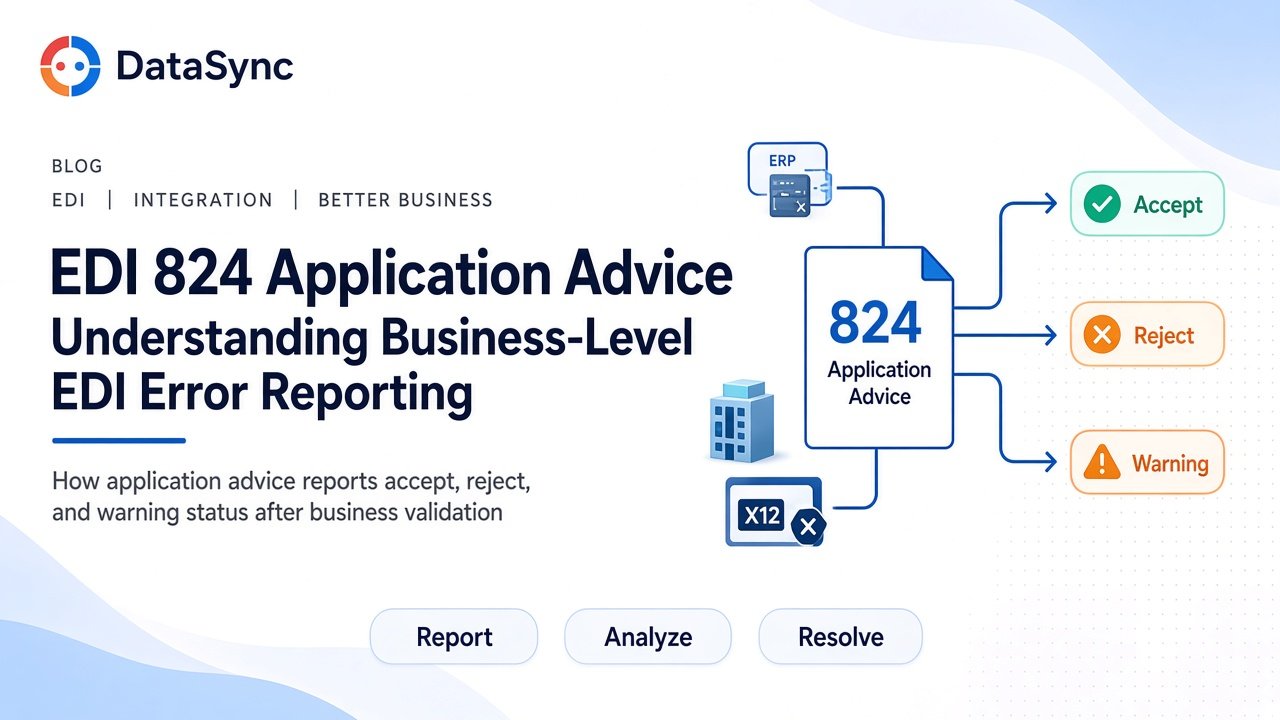
EDI 824 Application Advice: Understanding Business-Level EDI Error Reporting
- DataSync
- 09 Oct, 2026
- 03 Mins read
- Edi
An EDI 824 Application Advice is how a trading partner reports business-level acceptance, rejection, or warnings after a transaction reaches their application. It is not the same as a transport receipt or a structural acknowledgment. It answers a more important operations question: did the receiving business system actually accept the data?
If your team works with purchase orders, invoices, shipment notices, or other X12 documents, understanding the 824 helps you move from “the file was received” to “the business process can continue.”
What EDI 824 Application Advice Is Used For
The 824 is used when a receiver needs to communicate application results back to the sender.
That can include:
- Full acceptance of a transaction
- Partial acceptance with warnings
- Rejection because of business rule failures
- Detailed error codes that explain what failed
In practical terms, the 824 is the EDI document that tells you whether the receiving application could process the content, not just whether the envelope and syntax looked valid.
How 824 Differs From 997 and 999
Many teams confuse acknowledgments because several documents can appear after an EDI send.
- A 997 usually confirms structural or functional acknowledgment at the transaction-set level.
- A 999 often provides more detailed implementation-guide validation feedback.
- An 824 reports application-level advice after deeper business checks.
That means a document can receive a successful 997 and still later receive an 824 rejection if the application finds an invalid item, missing reference, pricing issue, or partner-specific business rule failure.
What Business-Level Errors Usually Mean
Business-level EDI error reporting is about content and process readiness, not just format.
Common 824-driven issues include:
- Unknown or inactive trading partner identifiers
- Invalid item numbers, UPC values, or SKUs
- Missing purchase order or shipment references
- Quantity, price, or date values that violate partner rules
- Duplicate business documents already accepted by the application
- Warehouse, store, or location codes the receiver cannot process
These are the kinds of problems that can stop order fulfillment, invoicing, or shipment updates even when the EDI file itself looks syntactically correct.
How to Read an EDI 824 Effectively
A useful 824 review should answer four questions quickly:
- Which original transaction is being advised on?
- Was the result accept, reject, or accept with errors?
- Which fields or segments caused the issue?
- What action should the sender take next?
Operations teams should not stop at “we got an 824.” They should map the advice back to the original 850, 810, 856, or other source document and decide whether to correct and resend, escalate to the partner, or update master data.
Why 824 Monitoring Matters for EDI Operations
Without clear 824 handling, teams often assume a transaction is complete because delivery and structural acknowledgments succeeded. That creates silent operational risk.
Strong 824 monitoring helps teams:
- Detect application rejections faster
- Reduce chargebacks and delayed fulfillments
- Improve partner communication with specific error context
- Close the loop between EDI success and business process success
In mature EDI programs, the 824 is treated as a first-class exception signal, not a secondary status message.
Best Practices for Handling Application Advice
Teams that manage 824s well usually follow a consistent process.
- Route 824 exceptions into the same queue as other EDI failures
- Preserve the link between the 824 and the original transaction ID
- Classify errors by type, partner, and document family
- Fix root causes in mapping, validation, or master data when patterns repeat
- Confirm with the partner when an error code is unclear or partner-specific
The goal is not only to resolve one rejected document. The goal is to reduce repeat business-level failures across the trading partner network.
Final Takeaway
EDI 824 Application Advice is the business-level layer of EDI error reporting. While 997 and 999 help confirm structure and implementation compliance, the 824 tells you whether the receiving application accepted the transaction for real business processing.
Teams that monitor, interpret, and act on 824s close the gap between technical EDI delivery and operational success. That is what keeps orders, invoices, and shipments moving with fewer preventable exceptions.
Our Team Members